
On this page
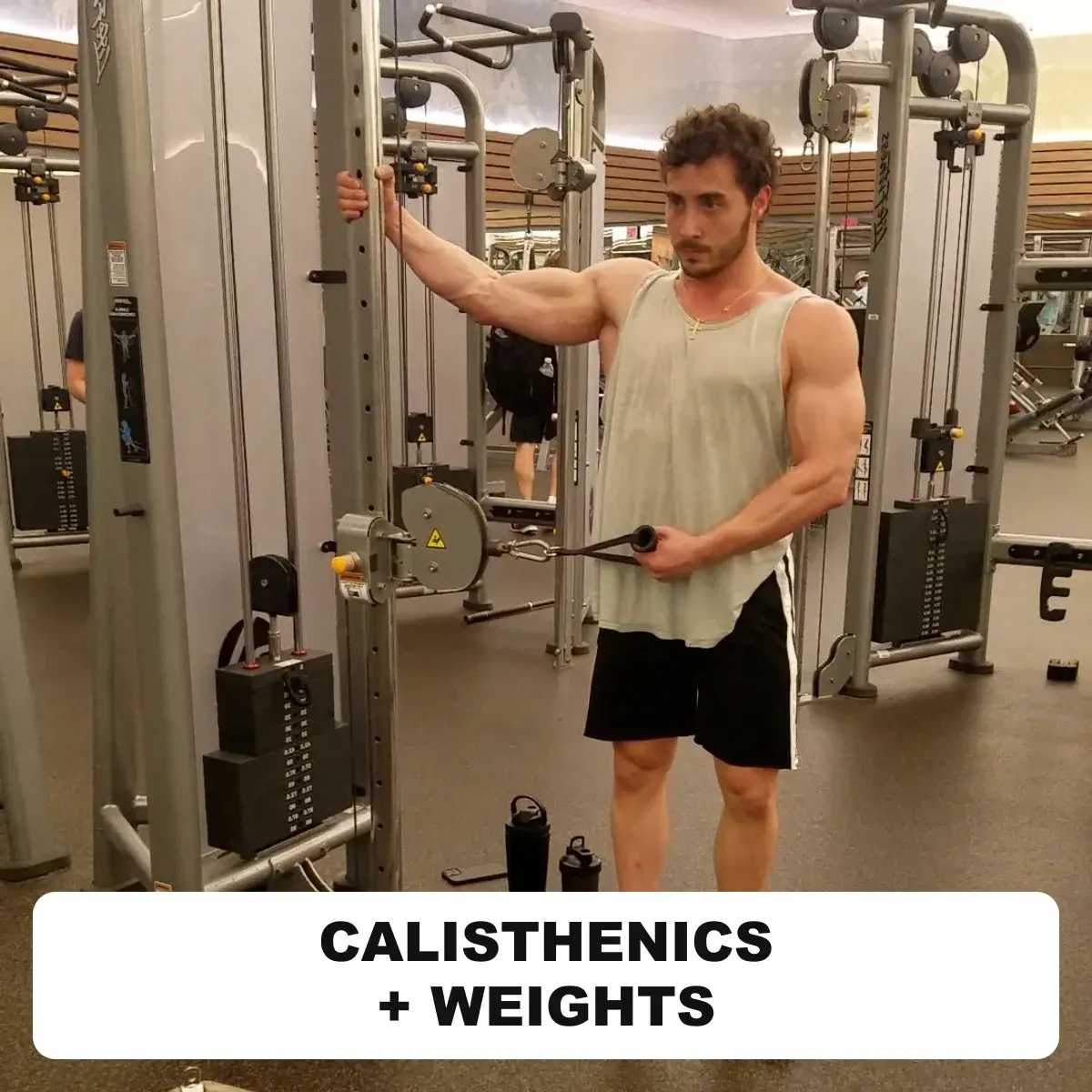
You can combine calisthenics and weight training in the same workout or across the week. The useful way to do it is to give each exercise a job, count the work together, and keep a schedule you can repeat. A pull-up and a lat pulldown both ask your back and arms to work. Calling one calisthenics does not make it extra recovery-free training.
If you want better bodyweight skills while building muscle, keep the relevant calisthenics progressions in your plan. Use weights where they make a movement easier to load, measure, or aim at a muscle you want to develop.
My Bodyweight Calisthenics Workout Program provides a useful method for making those decisions. It is a calisthenics-focused program, not a hybrid routine. What follows is an explanation of its progression and scheduling method, then practical ways to adapt that method when you also want to lift weights. These examples are not a record of my personal training week.
If you are still wondering whether bodyweight work can build size at all, start with can calisthenics build muscle?. Here, the question is how to organize both styles without making your program twice as long.
Start with a movement path and a reason for following it
In my program, an exercise slot often gives you a path instead of a single exercise name. You follow the indicated route on the chart and choose the most difficult variation you can safely complete for the prescribed repetitions or hold duration.
If you can barely perform a movement once, it is not the right variation for a set of eight. Pick the exercise that fits the work you are trying to do today.
The printed program uses numbered paths and lettered branches. For example, a path marked 2-C-E tells you where to start and which branches to follow. It does not tell you to perform every exercise along the way. You are finding your current working variation within that path.
Use the calisthenics progression explorer to inspect the connected exercises and read their instructions. The explorer contains the latest reviewed relationships; the program's path codes belong to its included chart. Do not assume the website's branches and the printed codes are interchangeable. The graph also cannot test whether you are ready for a movement.
For a hybrid plan, decide which paths you actually care about progressing. Perhaps you want your first pull-up and more controlled push-ups. Keep those movements in the week. You can still use dumbbells for your legs or a cable for your side delts without needing a separate calisthenics progression for every muscle.
Match the exercise to the reps or hold time
Some paths move between repetition exercises and static holds. The program supplies separate targets for those two types of work, with the prescribed set count applying to either. Use the target for the exercise you selected. A 20-second hold is not 20 repetitions, and improving one does not automatically prove that the other improved.
As an example, suppose a slot calls for 8 to 12 repetitions. Choose a variation that makes that range useful. If you can only do three controlled pull-ups, use an appropriate assisted variation for that slot. If 12 repetitions have become easy, reassess the difficulty.
The program allows a harder variation, a tempo adjustment, or added weight when the current exercise no longer provides enough challenge. You do not have to abandon a movement that is working just because the next branch looks more impressive. Adding a small load to a controlled pull-up can be a more manageable change than jumping to an advanced variation you cannot yet control.
Keep the setup consistent while you assess it. For ring rows, record ring height and foot position. For a weighted exercise, record the load. Log your reps or hold duration, and note how much clean work you had left. The program explains reps in reserve for this purpose; the site's guide to training near failure covers the same distinction in more detail.
Replace overlapping work before adding more
Start with the exercises already in your week. Which weighted movement would solve a problem that the current exercise is not solving?
| What you want to keep | Where weights could help | What to review before adding them |
|---|---|---|
| Pull-up progression | A pulldown provides another adjustable pulling option | Replace some existing vertical-pull work instead of adding a second full back session |
| Push-up or dip progression | Dumbbell pressing gives you another way to load a press | Count both toward the week's chest, shoulder, and triceps work |
| Single-leg squat practice | A loaded split squat can train the legs without requiring the same balance skill | Keep skill practice modest if the weighted work supplies most of your hard leg sets |
| Bodyweight leg-curl progression | A leg-curl machine allows small load changes | Compare the knee-flexion work already in your plan before adding sets |
These are programming choices, not claims that the exercises are identical. A pulldown will not teach every part of a pull-up, and a dumbbell press will not teach ring support. If you want a particular skill, you still need to practice that skill or a suitable progression toward it.
For example, if you currently perform six challenging horizontal-push sets across the week, a first experiment might be three push-up sets and three dumbbell-press sets. You have changed how you do the work while keeping six sets. Three sets of each added on top of the original six would be a very different experiment.
Likewise, your triceps do not stop contributing because a set was labeled chest. Count the overlap when deciding whether you need extra arm work, without pretending every compound set provides exactly the same stimulus as an isolation set. The weekly training-volume guide explains how to use set counts without treating them as perfect measurements.
Use frequency to spread out the work
My calisthenics program has five training days, plus two additional days for mobility or flexibility. The training days have different emphases, including a core-focused day. They are not five copies of the same full-body workout.
The weekly structure repeats. As your ability changes, you reassess the exercise within each assigned path. That gives you something consistent to compare without requiring a new routine every Monday. The program also tells you to reduce sets for muscles that are not recovering adequately.
When adapting that schedule, keep the purpose of each day and check how it affects your next session. You want a week you can repeat productively.
Here is an example of adapting that rhythm. It is a planning outline, not the full program or an instruction to add all of these exercises to it.
| Day | Emphasis | Example hybrid decision |
|---|---|---|
| 1 | Mixed pushing, pulling, and legs | Keep a priority bodyweight pull; use a loaded squat variation in the leg slot |
| 2 | Different upper-body emphasis and posterior legs | Keep the selected push progression; use a leg curl for knee-flexion work |
| 3 | Core-focused work and controlled pulling | Preserve the core emphasis instead of turning it into another pressing day |
| 4 | Mobility or rest | Leave room to recover; do not automatically make this a weights day |
| 5 | Mixed strength and muscle-building work | Repeat a priority progression and compare it with the earlier session |
| 6 | Remaining selected paths | Retain useful skill or hold work and check overlap with the previous day |
| 7 | Optional flexibility or rest | Review the log before repeating the week |
You do not need five training days to build muscle. A 2019 meta-analysis of 25 studies found no significant hypertrophy difference between higher and lower training frequencies when weekly volume was matched. Choose a frequency that lets you get the work done and recover from it.
If your schedule only supports three days, use a plan written for three days. Cramming five sessions into three does not preserve the recovery arrangement. You can still apply the same path-selection and substitution method within a shorter plan.
Put your priority early in the workout
After warming up, start with the movement you most want to improve. If the goal is better pull-ups, do them before tiring your pulling muscles with rows and curls. If your current priority is bench-press strength, bench first and place the bodyweight pressing accordingly.
A review of exercise order found that strength gains tended to favor exercises performed earlier in the session. It did not find a significant hypertrophy difference between the exercise orders studied. That supports prioritizing a lift, not a blanket rule that calisthenics must always come before weights.
Be honest about what you call skill practice, too. A few easy balance attempts and repeated near-maximal holds are different demands. When the skill work is hard strength work, include it in the day's workload. Stop or regress when control breaks down; pain is a reason to stop, not a progression target.
Buy equipment when it gives you a useful option
Rings are useful if you have a suitable place to anchor them and want adjustable-height rows or push-ups. The equipment catalog includes these wooden gymnastics rings. You can change the setup to match your current ability, then record it so next week's sets are comparable. Follow the equipment's installation instructions and use a properly rated anchor.
If your gym already provides what you need, use that first. You do not need rings, a vest, a belt, and a new set of dumbbells just to call your training hybrid.
What to change when progress stalls
Look at the log before adding another exercise. Did your variation change? Are you resting less between sets? Did you add weighted pressing but leave every dip and push-up set in place? If performance is falling across repeated sessions, review that combined workload along with sleep and food. The recovery guide can help you work through those checks.
Keep the changes small enough to understand. Replace one overlapping exercise, run the revised week, and track what happens. If it works, you have a reason to keep it. If it makes the next session worse, you have a specific change to reconsider.
The calisthenics program gives you the full path assignments, set and rep or hold targets, tracking tables, and explanations behind the schedule. Use it alongside the progression explorer to understand your exercise options. Then any weight training you include should have a clear place in that schedule and a reason for being there.
Common questions
Frequently asked questions
Can I do calisthenics and weight training on the same day?
Yes. Put the movement you most want to improve early in the session, then choose the remaining work around it. Count demanding bodyweight sets and weighted sets together when reviewing how much work a muscle receives.
Should I do calisthenics before or after weights?
Start with your priority after warming up. A pull-up goal can put pull-ups first; a bench-press goal can put bench first. Brief, low-fatigue skill practice is different from hard strength work, so judge the actual effort rather than the exercise label.
Is the GymDaze calisthenics program a hybrid weight-training program?
The published program is calisthenics-focused: five training days with two additional mobility or flexibility days. This article explains how to adapt its movement-path and scheduling method when you want to include weights; it does not replace the program's full prescription.
Do I have to train five days a week to combine calisthenics and weights?
No. Five days is the layout of the GymDaze calisthenics program, not a requirement for hybrid training. Use a schedule you can repeat and recover from. If you need fewer days, use a plan written for that schedule rather than compressing all five sessions into fewer, much longer workouts.
References