
On this page
To judge a food's protein claim, check how much you'll actually eat and how many grams of protein and calories that portion provides. Start with the Nutrition Facts panel, even if the front of the package is covered in protein claims.
In the video, I go through four things that can make a label confusing: protein claims, zero-calorie servings, net carbs and serving sizes. A few details deserve more precision here, particularly the calorie-rounding rule and what I mean when I call something a good protein source. These notes apply to U.S. Nutrition Facts labels.
Compare the protein with the calories
Peanut butter, hummus and chickpeas are the examples I open with. They contain protein. The question I want you to ask is how much of that food you'd need to eat to get the amount of protein you're looking for, and what else comes with it.
For a quick comparison, divide the grams of protein by the calories and multiply by 100. That tells you the grams of protein per 100 calories. These made-up labels show the calculation:
| Example serving | Protein | Calories | Protein per 100 calories |
|---|---|---|---|
| Food A | 8 g | 200 | 4 g |
| Food B | 15 g | 150 | 10 g |
Food B gives you more protein for the same calories. Whether it's the better purchase still depends on what you're eating it for, what it costs and whether you like it. A food can contribute fiber, fats or other nutrients without being the most concentrated way to add protein to a meal.
The video uses a different expression of the same comparison: the approximate percentage of calories from protein. Multiply protein grams by four, divide by the serving's calories and multiply by 100. Food A works out to 16%; Food B works out to 40%. Four calories per gram is the general protein factor used in U.S. labeling rules.
My 30% cutoff in the video is a rough shopping preference. The regulatory meaning of “good source” is based on Daily Value, not that percentage. Protein concentration alone also won't tell you whether a food belongs in your diet. Your meals can contain a mixture of foods that contribute different things; every ingredient doesn't need to match your whole day's macro targets.
Protein quality also takes more explanation than the short video gives it. Your body needs essential amino acids from food, but you don't have to get them all in ideal proportions from each individual ingredient. A varied selection of protein-containing plant foods can supply them across the day. Harvard's protein guide explains that distinction. Don't erase the protein in beans or grains from your count because you heard the word “incomplete.”
Zero on the label can be a rounded number
I've had friends and people I've worked with tell me they don't count cooking spray because the can says zero calories. Look closely at the serving size before treating that as a description of everything you've sprayed into the pan.
The threshold needs correcting from the video: U.S. Nutrition Facts rules allow a serving with fewer than five calories to be displayed as zero. It doesn't have to be less than one calorie. Several tiny servings can therefore supply energy even when each serving rounds to zero. See 21 CFR 101.9(c)(1).
A brief spray and a long coating of the pan are different amounts. If you track cooking oil, use a measurable quantity or a reliable entry for the amount used. Multiplying a rounded zero by ten won't recover the calories that disappeared in rounding. Check the portion and ingredients before deciding whether a zero is misleading.
Fiber doesn't cancel the sugar beside it
On a U.S. label, dietary fiber is included within total carbohydrate. The indentation shows how the carbohydrate total is broken down. The FDA's label guide walks through that layout.
Suppose a product lists 20 grams of total carbohydrate and 5 grams of fiber. Subtracting the fiber gives 15 grams of non-fiber carbohydrate. It doesn't remove an additional 5 grams of sugar from the food. That's the misunderstanding I'm getting at in the video.
Don't use a front-label “net carbs” number to recalculate the product's calories. Fiber and sugar alcohols can have different energy values, and rounding affects the displayed numbers; the labeling rules specify several calculation methods. For calorie tracking, start with the listed calories and the portion eaten. My shortcut in the video of subtracting protein and fat calories from the total isn't an exact way to reconstruct carbohydrate grams.
Match the serving to your portion
Check whether the numbers describe a spoonful, a measured weight or the whole package. If the label describes half of what you eat, you need twice the listed calories and nutrients. Where a label has separate per-serving and per-container columns, use the one that matches your portion.
Serving sizes are generally based on amounts people typically consume; they aren't a personal recommendation for how much you should eat. The FDA's serving-size explanation covers both points. You can eat more or less, but your tracking needs to reflect it.
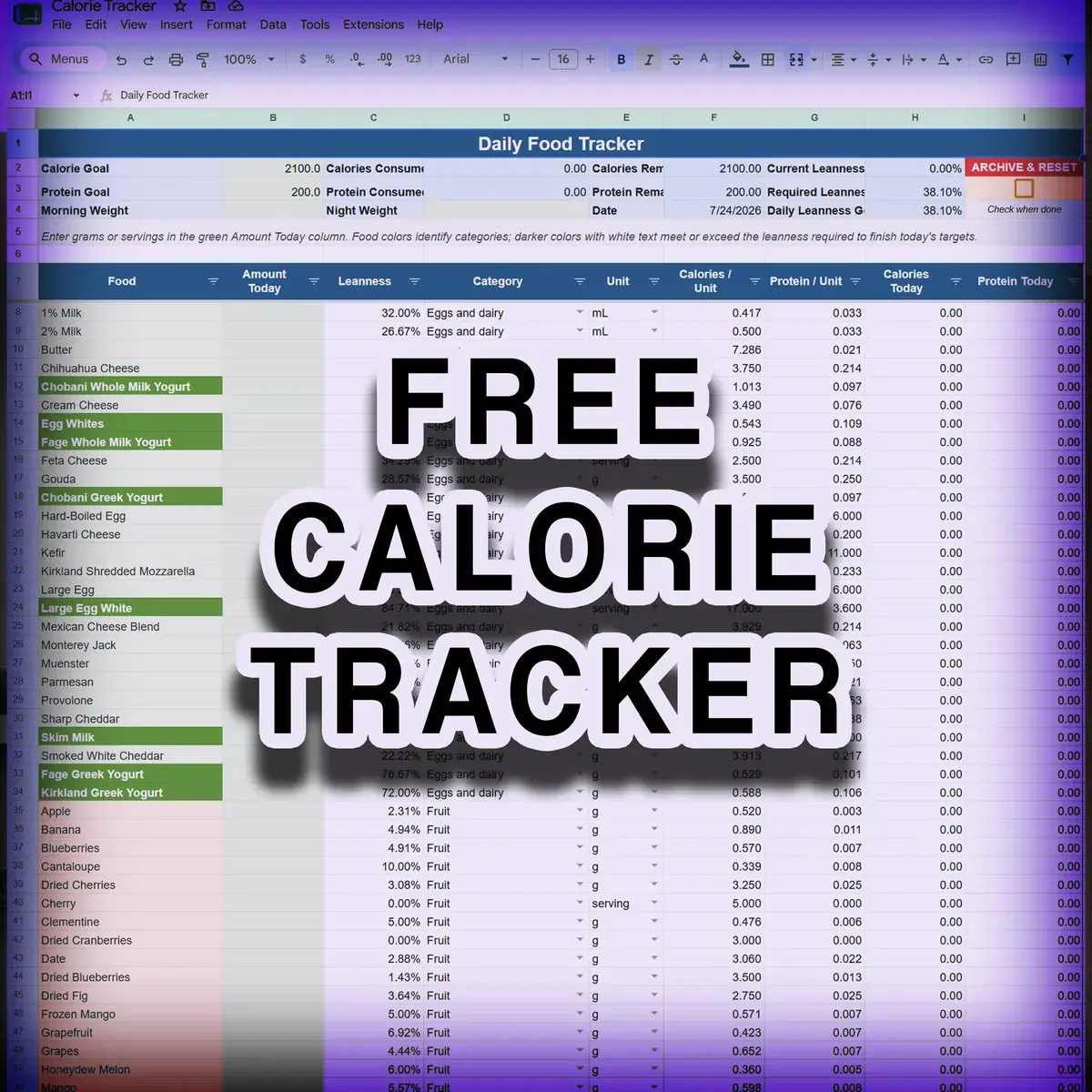
Next time you're comparing two foods, turn the packages around and put the numbers on the same basis. Check the portion first, then protein and calories, and consider the rest of the food and its price. The nutrition fundamentals guide explains how those choices fit together. If you're already keeping a record, the calorie and protein tracking sheet gives you a place to put the amounts you actually eat.
Common questions
Frequently asked questions
Does zero calories on a U.S. label always mean no energy?
No. An amount below five calories per serving may be displayed as zero. Check the serving size, especially if you use many tiny servings of an oil-based cooking spray.
References