
On this page
- What this tracker is
- The part that makes it different
- Why calorie and protein tracking is really a ratio problem
- How foods unlock during the day
- A simple example day
- How to use the Food Tracker
- Why the food database is one continuous table
- What the Daily Log and Dashboard add
- Why this is useful if you already track
- What this tracker does not know
- How I would actually use it
What this tracker is
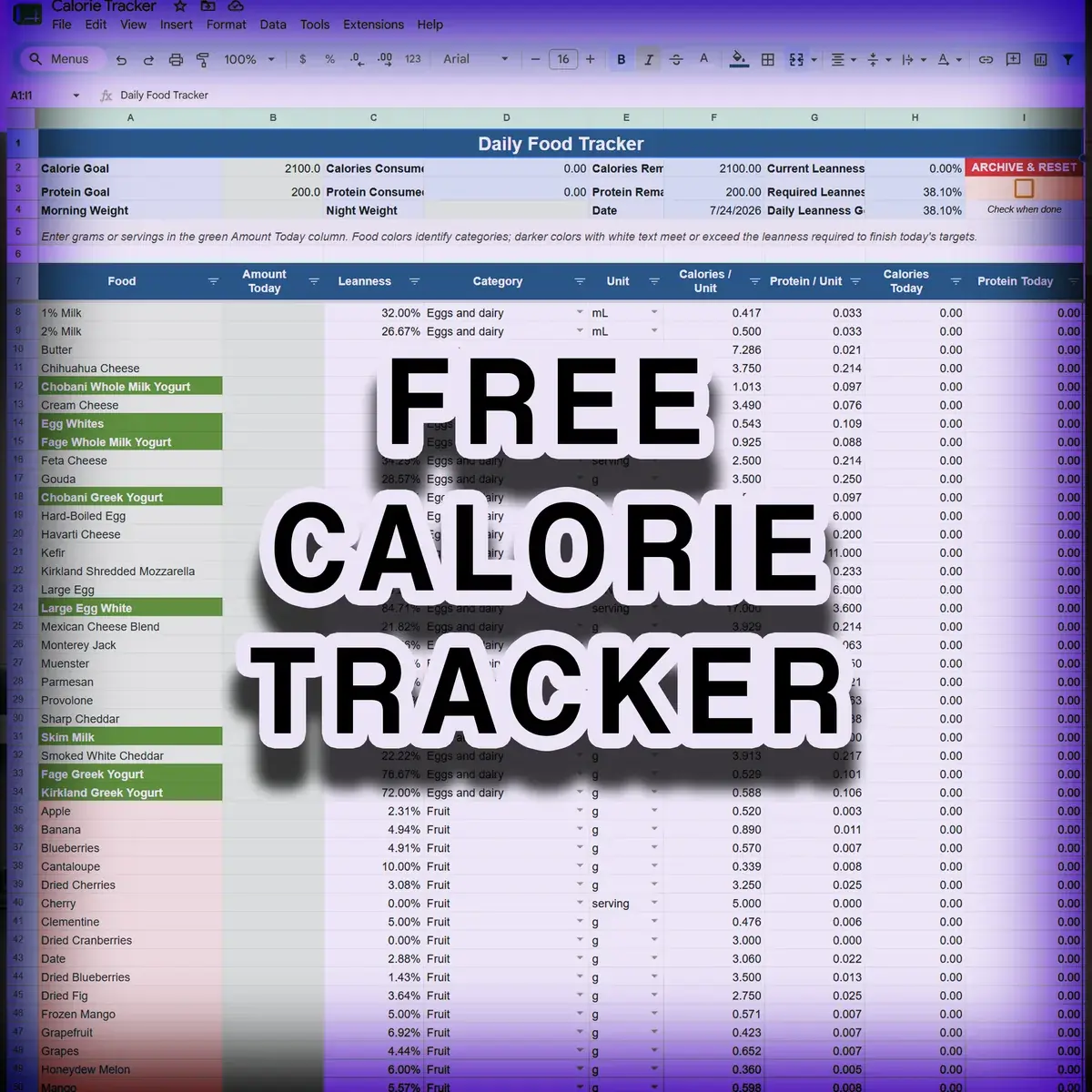
This free calorie, protein, and weight tracking spreadsheet helps answer a question normal calorie counters do not handle very well: are the foods you are choosing protein-dense enough to meet your daily targets?
You can make your own copy of the GymDaze tracker here. Make a copy first, then edit your version. Do not try to use the public template as your personal log.
The tracker will not pick your goal calories, rank foods as morally superior, or account for your medical history. It helps you manage calorie and protein targets. The Nutrition Fundamentals guide covers the concepts behind those targets.
You set a calorie goal and a protein goal. As you log foods, the spreadsheet shows whether each choice helps you finish the day on target or makes the rest of the day harder.
That is the part I care about. A lot of trackers tell you what already happened. This one is built to change the next choice.
The part that makes it different
The Food Tracker is built around something I call leanness.
In this sheet, leanness means the percentage of a food's calories that come from protein. It is not the same thing as low-fat. It is not the same thing as low-calorie. It is definitely not a complete score for how healthy a food is.
It is protein-calorie density.
The formula is:
Food leanness = (protein grams x 4) / calories
The reason protein gets multiplied by 4 is that protein provides about 4 calories per gram, which is the same value listed by the USDA Food and Nutrition Information Center. So if a food has 25 grams of protein and 200 calories, then 100 of its calories come from protein. That food has a leanness score of 50%.
Again, this does not mean it is 50% healthy. It means half of the calories in that food come from protein.
That one distinction matters because most people trying to lose fat and keep or build muscle are not just trying to eat fewer calories. They are trying to eat fewer calories while still getting enough protein. Those two numbers are connected. If your calorie goal is tight and your protein goal is high, then the foods you choose have to pull their weight.
Why calorie and protein tracking is really a ratio problem
A normal tracker treats calories and protein like two separate chores. Stay under this number. Hit that number. Good luck.
But in real life, they fight each other a little.
If you eat a lot of calories without much protein early in the day, you do not just have fewer calories left. You also have more protein left to fit inside those fewer calories. That makes the rest of the day more demanding.
If you eat more protein-dense foods early, you bank protein while spending fewer calories. Then the remaining foods do not have to be as lean. You bought yourself flexibility.
This is why the tracker starts by calculating a Daily Leanness Goal:
Daily leanness goal = (daily protein goal x 4) / daily calorie goal
For example, if your goal is 160 grams of protein and 2,000 calories, then your daily leanness goal is 32%. That means 640 of your 2,000 calories would come from protein if you hit both targets exactly.
The sheet then uses Required Leanness to account for what you have already eaten:
Required leanness = (remaining protein x 4) / remaining calories
Required Leanness changes all day as you enter foods. It tells you how protein-dense the rest of your food needs to be from this point forward if you still want to finish the day on target.
How foods unlock during the day
Every food in the tracker has its own leanness score. The Food column is lightly colored by category so the table is easier to scan. Eggs and dairy, meat and seafood, fruit, grains and starches, protein supplements, sauces, snacks, vegetables, and prepared meals all stay visually distinct without needing a bunch of separate mini-tables.
When a food's leanness is equal to or higher than your current Required Leanness, that food changes into a darker version of its category color with bold white text. In plain English, that food is currently unlocked.
Unlocked does not mean mandatory. Locked does not mean forbidden.
Unlocked means this food currently fits the protein density you need for the rest of the day. Locked means eating it now would require you to compensate with leaner choices somewhere else.
That is a much better mental model than calling foods good or bad. A bagel might be hard to fit at breakfast if you have not eaten any protein yet. The same bagel might be completely fine later if you already handled a lot of your protein with yogurt, chicken, egg whites, lean meat, or a shake.
The food did not change. Your position in the day changed.
A simple example day
Here is a hypothetical example. These are not my personal nutrition numbers. They are just simple numbers to show the logic.
Say your daily target is 2,000 calories and 160 grams of protein. Your starting Daily Leanness Goal is 32%.
At the beginning of the day, your Required Leanness is also 32%, because you still have the full day left.
Now imagine breakfast is 300 calories and 50 grams of protein. That meal has 200 calories from protein, so it is about 67% lean by this sheet's definition. After breakfast, you have 1,700 calories left and 110 grams of protein left.
Your new Required Leanness is:
(110 x 4) / 1,700 = about 26%
Because you ate a protein-dense breakfast, the rest of the day no longer needs to average 32% leanness. It only needs to average about 26%. More foods are now unlocked. You have more room for foods that are useful, enjoyable, or simply normal human eating.
Now flip it around.
Say breakfast is 600 calories and only 15 grams of protein. You still have 1,400 calories left, but now you need 145 grams of protein.
Your new Required Leanness is:
(145 x 4) / 1,400 = about 41%
That does not mean breakfast was illegal. It means the rest of the day has to be much leaner if you still want to hit both goals. Fewer foods will be highlighted. The sheet makes that obvious immediately instead of waiting until 9 p.m. to tell you that your remaining dinner options are sadness and math.
How to use the Food Tracker
During normal use, the three columns you will care about most are Food, Amount Today, and Leanness.
The Food column tells you what is in the database. The Amount Today column is where you enter what you ate. The Leanness column tells you how protein-dense that food is relative to its calories.
The rest of the columns are still important, but they are more for maintaining the database:
- Category
- Unit
- Calories per Unit
- Protein per Unit
- Calories Today
- Protein Today
The basic workflow is:
- Weigh the food or decide how many servings you ate.
- Enter that amount in Amount Today.
- Check the Unit column so you know whether the row expects grams, milliliters, tablespoons, cups, items, or servings.
- Let Calories Today and Protein Today calculate automatically.
- Watch the summary update calories consumed, calories remaining, protein consumed, protein remaining, current leanness, and required leanness.
- Use the new highlighting to see which foods are unlocked or locked based on your current position.
This also pairs well with the basic label-reading habit the FDA explains on Nutrition Facts labels: serving size matters because the calories and nutrients shown on the label belong to that serving. The tracker uses the same basic idea, but turns it into your actual amount eaten instead of the serving the package happens to advertise.
You can also enter morning and night weights if you want the sheet to track body-weight data alongside food intake. Then, at the end of the day, use the in-sheet Archive and Reset control. It is designed to save the day's totals to the Daily Log and clear the Amount Today and weight-entry fields for the next day. This happens through the spreadsheet itself, not through a ChatGPT automation.
Why the food database is one continuous table
The food database is one continuous table, so adding a food does not require rearranging separate category sections.
If you want to add a new food, you do not need to shove an entire section downward or keep every category perfectly arranged forever. Add the food to a blank row, choose the category, set the unit, enter the calorie and protein values, and let the formulas handle the rest.
The category color still makes it visually obvious what kind of food it is. The sheet can stay organized without becoming fragile.
A tracker that is annoying to maintain eventually stops getting used. This one needs to be easy enough to update after a normal grocery trip.
What the Daily Log and Dashboard add
The Food Tracker is for making decisions today. The Daily Log and Dashboard are for seeing what those decisions are doing over time.
The Daily Log stores one row per completed day. It includes calories, protein, morning weight, night weight, average weight, weight change compared with the previous day, morning-to-night change, and protein-calorie percentage.
The Dashboard turns that history into longer-term feedback. The public sheet I inspected includes cards for latest weight, 7-day average weight, change versus 7 logs ago, days logged, 7-day average calories, 30-day average calories, 7-day average protein, and 7-day protein-calorie percentage. It also includes charts for weight trend, calories versus goal, and protein trend.
That is important because weight is noisy. MedlinePlus notes that body weight includes muscle, bone, fat, and water, and everyday factors like diet, activity, stress, sleep, genetics, and age can affect it. So a single weigh-in can be useful, but a trend is usually more useful.
If you are trying to lose fat, build muscle, or maintain your weight while training hard, the day-to-day numbers are not the whole story. The bigger question is whether your average intake and average weight are moving in the direction you intended.
Why this is useful if you already track
This tool is probably most useful for someone who already understands the basics. If calories, protein, and body weight are all brand new to you, start with the GymDaze TDEE Calculator, the GymDaze Protein Intake Calculator, and the Nutrition Fundamentals guide first.
Once you have targets, this tracker becomes much more useful.
There is good reason to care about tracking in the first place. The CDC includes nutrition tracking and progress monitoring as part of a practical weight-loss process, and systematic reviews have found that dietary self-monitoring can support weight-loss efforts, even though adherence and study methods vary. PMC
Protein targets matter for lifters too. The International Society of Sports Nutrition has placed many exercising individuals around 1.4 to 2.0 grams of protein per kilogram of body weight per day. PubMed
A large protein and resistance-training meta-analysis also found that muscle-gain benefits from added protein tend to level off around a practical range for many lifters. PubMed
But knowing the targets is only step one. The hard part is making food decisions all day without turning every meal into a spreadsheet in your head. This is where the unlocking system helps.
It gives you a quick answer to a better question: if I eat this now, what does it do to the rest of my day?
What this tracker does not know
There are a lot of nuances this tracker does not try to solve.
Leanness only measures protein density. It does not measure micronutrients, fiber, food quality, fat quality, allergies, digestion, blood sugar response, sodium, cholesterol, food cost, taste, convenience, satiety, medical needs, or whether you are actually going to enjoy eating the food.
Olive oil will have a terrible leanness score because it has no protein. That does not make olive oil bad. Fruit will usually have a low leanness score because most of its calories do not come from protein. That does not make fruit useless. Salmon may be less lean than chicken breast while still being a perfectly good food.
The tracker is not ranking your food as worthy or unworthy. It is answering one narrow question: how does this food fit your remaining calorie and protein budget?
If you have medical conditions, disordered eating concerns, a history of extreme dieting, or nutrition needs that go beyond normal fitness goals, this is not a substitute for individualized advice from a qualified professional. It is a decision aid, not a diagnosis or prescription.
How I would actually use it
If I were using this from scratch, I would keep it pretty simple.
First, set a realistic calorie target. If you are not sure where to start, use the GymDaze TDEE Calculator or the GymDaze Bodyweight Planner to get into the right neighborhood. Do not make the tracker responsible for fixing a goal that was unrealistic from the start.
Second, set a protein target you can repeat. The protein calculator can give you a practical number, and the body recomposition guide explains why protein, calories, lifting, recovery, and tracking all need to work together instead of being treated as separate magic buttons.
Third, use the Food Tracker for a week without trying to be perfect. A food scale can reduce portion guesswork, but it is not required. Watch which foods unlock early, which ones stay locked until later, and which meals make the rest of the day easier or harder.
Over that week, watch for patterns: some foods help your ratio, others fit because you have already met much of your protein goal, and others use up more of your remaining calorie budget.
The main point is not to eat the leanest possible food all day. That would be miserable and probably unnecessary. The point is to understand the tradeoff while there is still time to do something with it.
If this works for you, it can make calorie and protein tracking feel less like punishment and more like a set of decisions you can actually steer.
References