
On this page
- First, figure out what kind of “cranky” you mean
- Stop starting leg day cold
- Use pain as feedback, not a personal attack
- Build the muscles that make your knees feel less dramatic
- Good support exercises for cranky knees
- Knee sleeves can help, but they are not a cure
- Change the exercise, not the whole goal
- Watch your weekly leg-day load
- A simple cranky-knee leg day template
- Warm-up
- Main lift
- Secondary lift
- Single-leg work
- Knee support finisher
- What not to do when your knees feel cranky
- FAQ
- Are squats bad for cranky knees?
- Do knee sleeves fix knee pain?
- How long should I warm up before leg day?
- When should I see a doctor for knee pain?
- Train legs like you want to keep training legs
Health note: This article is general education, not a diagnosis or individualized medical advice. Stop training and seek qualified care for severe or worsening pain, sudden swelling, deformity, inability to bear weight, locking, instability, fever, numbness, or an acute injury with a pop.
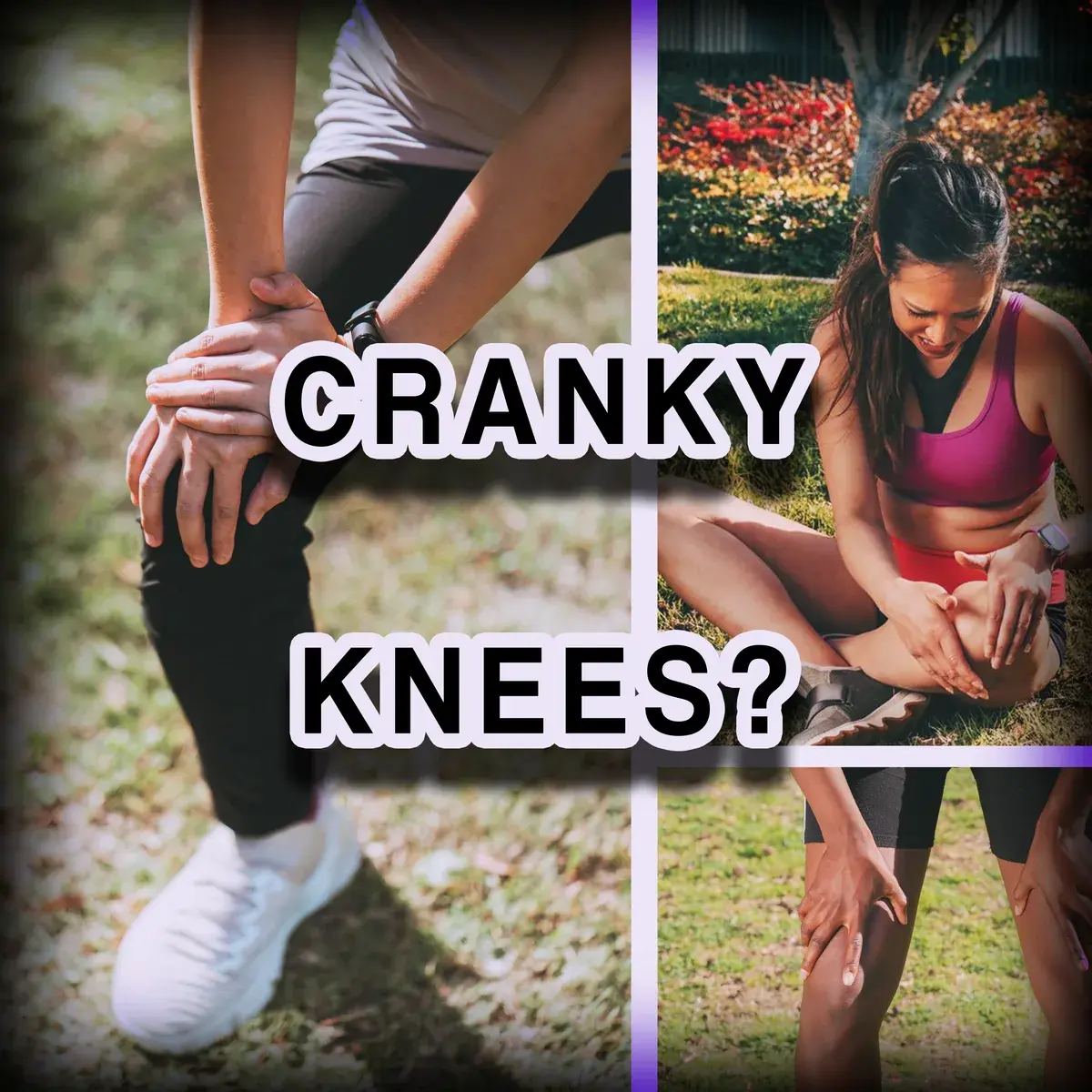
If your knees feel cranky during leg day, the fix is usually not "skip legs forever" or "push through and hope." Most of the time, you need to warm up better, adjust the exercises that irritate your knees, control your training load, and build more strength around the hips, quads, hamstrings, glutes, and calves.
That said, knee pain is not something to ego-lift through. If your knee suddenly swells, you hear a pop during an injury, you cannot bear weight, the joint looks deformed, or the pain is intense, get medical help instead of trying to troubleshoot it in the squat rack. Mayo Clinic lists those as signs that knee pain needs urgent attention.
First, figure out what kind of “cranky” you mean
Not all knee discomfort means the same thing.
A little stiffness at the start of leg day that improves as you warm up is different from sharp pain that gets worse every set. A dull ache around the kneecap during squats is different from a swollen knee that feels unstable. The fix depends on what your knee is actually telling you.
A useful rule:
- Warm, dull, low-level discomfort that improves with lighter movement: usually worth modifying and monitoring.
- Sharp, worsening, unstable, swollen, or injury-related pain: stop the workout and get it checked.
Find the amount of movement and loading your knees can handle today, then build that capacity over time.
Stop starting leg day cold
A lot of cranky knees are not "bad knees." They are cold knees being asked to go from sitting all day to heavy squats in five minutes.
Before lower-body training, start with 5 to 10 minutes of low-impact movement like cycling, incline walking, or an easy sled push if your gym has one. The American Academy of Orthopaedic Surgeons recommends a low-impact warm-up before knee conditioning work and also notes that you should not ignore pain during exercise. (OrthoInfo) If stretching is part of your warm-up, use the timing guidance in how long you should stretch.
A simple knee-friendly warm-up
Try this before your first heavy leg movement:
- Bike or incline walk: 5 to 10 minutes, easy pace
- Bodyweight squat to comfortable depth: 2 sets of 8 to 10
- Glute bridge: 2 sets of 10 to 15
- Band lateral walk: 2 sets of 10 steps each way
- Reverse lunge or split squat hold: 1 to 2 light sets per side
- Ramp-up sets: several easy sets before your working weight
That last part is where people get impatient. Your warm-up is not done just because you touched your toes once. If you are squatting 225 today, your knees usually want to see 45, 95, 135, and 185 before the real work starts.
Use pain as feedback, not a personal attack
Knee pain during leg day often shows up when the load, depth, tempo, stance, or weekly volume is more than your current tolerance.
That does not mean the exercise is automatically bad. It means you need to adjust the dose.
Start with these changes:
- Reduce range of motion until the movement feels smooth.
- Lower the load and slow the rep down.
- Use a box squat so depth stays consistent.
- Switch from forward lunges to reverse lunges since many lifters tolerate them better.
- Try a leg press with controlled depth instead of forcing barbell squats.
- Use tempo work instead of chasing heavier weight.
- Keep reps clean and stop before form starts getting weird.
If your squat has been feeling worse overall, it may not be a knee-only problem. It can be fatigue, poor exercise order, weak bracing, ankle mobility, or simply too much load too often. Gym Daze already has a deeper breakdown on that here: (GymDaze)
Build the muscles that make your knees feel less dramatic
Your knees do not work alone. The muscles around your hips, thighs, and lower legs help control where the knee travels and how much stress it has to absorb.
AAOS notes that strengthening the muscles that support the knee helps reduce stress on the knee joint, and their knee conditioning program targets the quads, hamstrings, abductors, adductors, glute medius, and glute max. (OrthoInfo)
For lifters, that usually means your "knee fix" should include more than just stretching your quads for 20 seconds.
Good support exercises for cranky knees
Add a few of these into your week:
- Spanish squat holds
- Step-downs
- Split squats
- Reverse lunges
- Hamstring curls
- Glute bridges or hip thrusts
- Calf raises
- Band lateral walks
- Terminal knee extensions
- Controlled leg extensions if tolerated
For kneecap-area pain specifically, physical therapy guidelines for patellofemoral pain emphasize hip and quadriceps exercises, including squats, lunges, step-downs, and banded hip work, as useful tools for reducing pain and improving function. (AAFP)
Stay within what your knee tolerates. Do not immediately add five new exercises to failure. Pick two or three movements, use controlled reps, and build slowly.
Fix your squat setup before blaming your knees
Squats are not automatically bad for knees. Bad loading choices, rushed warm-ups, poor control, and forcing a depth your body cannot own yet are usually the bigger issues.
Here are the big checks:
Your knees can move forward
A lot of lifters were told their knees should never go past their toes. That cue is too simple. Knees moving forward is normal in squats, especially if you squat deep or have longer femurs. The better question is whether you can control the movement without pain, collapsing, bouncing, or shifting.
Your feet need to stay planted
If your heels pop up, your weight dumps forward, and your knees may feel more stressed. Try a slightly wider stance, turn your toes out a bit, or use squat shoes if ankle mobility is limiting you.
Your depth should match your current control
You do not get bonus points for dive-bombing into a depth where your pelvis tucks, your arches collapse, and your knees hate you. Use the deepest range you can control well, then build from there.
Your working sets should not look like survival reps
If your first heavy set already looks ugly, the load is too high for today. Use the Gym Daze 1RM calculator to estimate smarter training loads instead of guessing and accidentally turning every leg day into a max effort session. (GymDaze)
Knee sleeves can help, but they are not a cure
Knee sleeves can make leg day feel better because they add warmth, compression, and a little support. For some lifters, that is enough to make squats feel smoother.
But sleeves do not fix poor programming, weak hips, bad fatigue management, or a movement pattern your knee does not tolerate yet. Think of them as a comfort tool, not a medical solution.
If your knees mainly feel stiff or cold during squats, a pair of GymReaper Knee Sleeves may be useful. If you are trying to decide between sleeves and wraps, Gym Daze already has a full comparison here: (GymDaze)
For warm-ups and hip work, resistance bands are also a practical option because they make lateral walks, terminal knee extensions, and glute activation work easier to set up. The resistance-band guide explains which style fits that job.
Change the exercise, not the whole goal
If barbell back squats make your knees angry right now, you still have plenty of ways to train legs.
Try these swaps:
- If back squats hurt: try goblet squats, box squats, safety bar squats, leg press, or split squats.
- If forward lunges hurt: try reverse lunges, step-ups, or supported split squats.
- If leg extensions hurt: shorten the range, slow the tempo, reduce load, or swap to Spanish squats.
- If deep knee bend hurts: train a partial range for now and gradually earn more depth.
- If high-volume leg day wrecks you: reduce sets before changing every exercise.
These adjustments let you keep training your lower body while removing the movement or load that currently irritates your knee.
Watch your weekly leg-day load
Knee irritation often reflects the amount of work you are doing and how well you recover from it.
Maybe you added more squat sets, more leg press, more lunges, and more cardio at the same time. Maybe you started cutting calories and kept your leg volume the same. Maybe you trained legs hard, slept poorly, then came back expecting your knees to act brand new.
This is where tracking helps.
For the next two weeks, write down:
- Exercises
- Sets and reps
- Load
- Pain level from 0 to 10
- Which movements felt better or worse
- Sleep and soreness
- Any jump in steps, running, sports, or cardio
If your knee pain climbs every week, your recovery and loading are not matching. Gym Daze has a related recovery article that fits this exact situation: (GymDaze)
A simple cranky-knee leg day template
Use this when your knees feel workable but not amazing.
Warm-up
- Bike: 5 to 10 minutes
- Glute bridge: 2 sets of 12
- Band lateral walk: 2 sets of 10 steps each direction
- Bodyweight box squat: 2 sets of 8
Main lift
Choose one:
- Box squat
- Goblet squat
- Leg press
- Safety bar squat
- Hack squat with controlled depth
Do 3 to 4 sets of 6 to 10 reps. Keep it smooth. Leave 2 to 3 reps in reserve.
Secondary lift
Choose one:
- Romanian deadlift
- Hip thrust
- Seated or lying hamstring curl
Do 3 sets of 8 to 12 reps.
Single-leg work
Choose one:
- Reverse lunge
- Supported split squat
- Step-up
- Low step-down
Do 2 to 3 sets of 8 to 12 per side.
Knee support finisher
Choose one or two:
- Spanish squat hold: 2 to 3 rounds of 20 to 45 seconds
- Terminal knee extension: 2 to 3 sets of 15 to 25
- Calf raise: 2 to 3 sets of 12 to 20
If you want a structured lower-body plan instead of guessing every week, the Gym Daze Legs Focus Workout Program is built around progressive lower-body training. Just remember: if your knee is actively irritated, modify movements and loads instead of forcing the plan exactly as written. (GymDaze)
What not to do when your knees feel cranky
A few common mistakes make this worse fast.
- Do not max out to "test it." A painful knee does not need a character-building PR attempt.
- Do not add five rehab drills at once. More exercises are not automatically better. Start small and track what helps.
- Do not stretch aggressively into pain. Mobility work should feel useful, not like you are trying to win a fight against your own joint.
- Do not rely only on sleeves. Sleeves may help comfort, but they do not replace smarter loading and stronger support muscles.
- Do not quit leg training completely unless you need to. Total rest can calm things down short term, but most lifters still need a gradual path back to training.
FAQ
Should I still train legs if my knees hurt?
You can usually train around mild, non-sharp discomfort if you can move normally and the pain does not worsen during the workout. Lower the load, shorten the range, and choose exercises that feel better. Stop if pain becomes sharp, unstable, swollen, or worse set to set.
Are squats bad for cranky knees?
Not automatically. Squats can be useful, but the version matters. A deep heavy back squat may feel awful while a box squat, goblet squat, or leg press feels fine. Match the squat to what your knees can tolerate right now.
Do knee sleeves fix knee pain?
No. Knee sleeves can provide warmth and compression, which may make training feel better, but they do not fix the reason your knee is irritated. Use them as support, not as permission to ignore pain.
How long should I warm up before leg day?
Start with 5 to 10 minutes of low-impact movement, then do movement-specific ramp-up sets before your working sets. If your knees usually feel stiff, spend more time warming up instead of rushing to the heavy stuff.
When should I see a doctor for knee pain?
Get medical help if the pain follows a major injury, your knee suddenly swells, you cannot bear weight, the joint looks deformed, you heard a pop during injury, or the pain is intense. Mayo Clinic also recommends making an appointment if the knee is badly swollen, red, warm, tender, very painful, or if ongoing pain affects sleep or daily tasks.
Train legs like you want to keep training legs
Cranky knees are frustrating, but they are also useful feedback. They usually mean something about your warm-up, exercise selection, load, depth, recovery, or support strength needs attention.
Start simple: warm up better, reduce the painful range, choose knee-friendly variations, build the muscles around the joint, and stop treating every leg day like a test of toughness.
Keep training within your knees' tolerance rather than avoiding leg day out of fear or pushing through it recklessly.
References