
On this page
- What problem are these supposed to solve?
- Knee sleeves vs knee wraps: the quick answer
- What knee sleeves actually help with
- Warmth
- Joint comfort
- Perceived stability
- Confidence under load
- Training situations where sleeves make sense
- What knee wraps actually do differently
- Knee sleeves vs knee wraps: what is the actual difference?
- Support
- Carryover
- Comfort
- Ease of use
- Best training context
- Best for beginners vs advanced lifters
- Who should buy knee sleeves?
- General gym lifters
- Bodybuilders
- People squatting for volume
- Lifters with cranky knees but otherwise decent movement
- Who should buy knee wraps?
- Powerlifters
- People specifically training with wraps
- Lifters who understand the tradeoff
- Who probably needs neither yet?
- When knee pain is not a gear problem
- Load management issues
- Poor exercise selection
- Technique breakdown
- Recovery and mobility limitations
- How to choose the right option
- Thickness
- Material feel
- Stiffness
- Fit and sizing
- Comfort for long sessions
- Ease of taking them on and off
- Common buying mistakes
- Buying wraps because they sound more hardcore
- Buying sleeves too tight
- Using support gear to ignore pain signals
- Assuming gear will fix bad squat mechanics
- Bottom line
- FAQ
- Do knee sleeves make you stronger?
- Are knee wraps cheating?
- Should beginners use knee sleeves?
- What thickness knee sleeves should I buy?
- Can knee sleeves help with knee pain?
Health note: This article is general education, not a diagnosis or individualized medical advice. Stop training and seek qualified care for severe or worsening pain, sudden swelling, deformity, inability to bear weight, locking, instability, fever, numbness, or an acute injury with a pop.
For most gym lifters, knee sleeves make a lot more sense than knee wraps. Sleeves can make squats feel warmer, more comfortable, and a little more stable. Wraps are a much more specialized tool. They can change the lift itself, which is exactly why some powerlifters use them and why most casual lifters do not need them.
A lot of people need neither yet. Before you buy, separate warmth, comfort, and confidence from actual carryover in the squat. Calling all of that "support" makes different pieces of gear sound interchangeable.
What problem are these supposed to solve?
Most people look at knee sleeves or knee wraps when one of three things is happening:
- Their knees feel beat up during squats or leg work.
- They want to feel more secure under heavier loads.
- They think support gear might help them lift more.
Those are not crazy reasons. The issue is that people often lump all of them together and start shopping before they know what they are actually trying to fix.
Sometimes the real problem is joint irritation from hard training. Sometimes it is just that heavier squats feel mentally better with a bit of compression around the knee. Sometimes it is poor load management, inconsistent technique, or recovery that is not keeping up with training. And sometimes, especially with wraps, the goal is performance in a very specific kind of squat.
That matters because knee sleeves and knee wraps solve different problems.
Knee sleeves vs knee wraps: the quick answer
Get knee sleeves if:
- you want warmth and joint comfort
- you like a bit of compression and perceived stability
- you squat regularly for strength or hypertrophy
- your knees feel cranky sometimes, but your movement is otherwise pretty solid
Get knee wraps if:
- you are a powerlifter who competes or trains in wraps
- you specifically want the rebound and carryover wraps can provide
- you understand that wraps change the feel and setup of the lift
Get neither yet if:
- you are still learning how to squat
- your knee issues are mostly coming from bad programming or poor recovery
- you are hoping gear will fix pain, technique, or movement problems by itself
That is the part most lifters need to hear first. Wraps are not just "more support." They are a different tool.
What knee sleeves actually help with
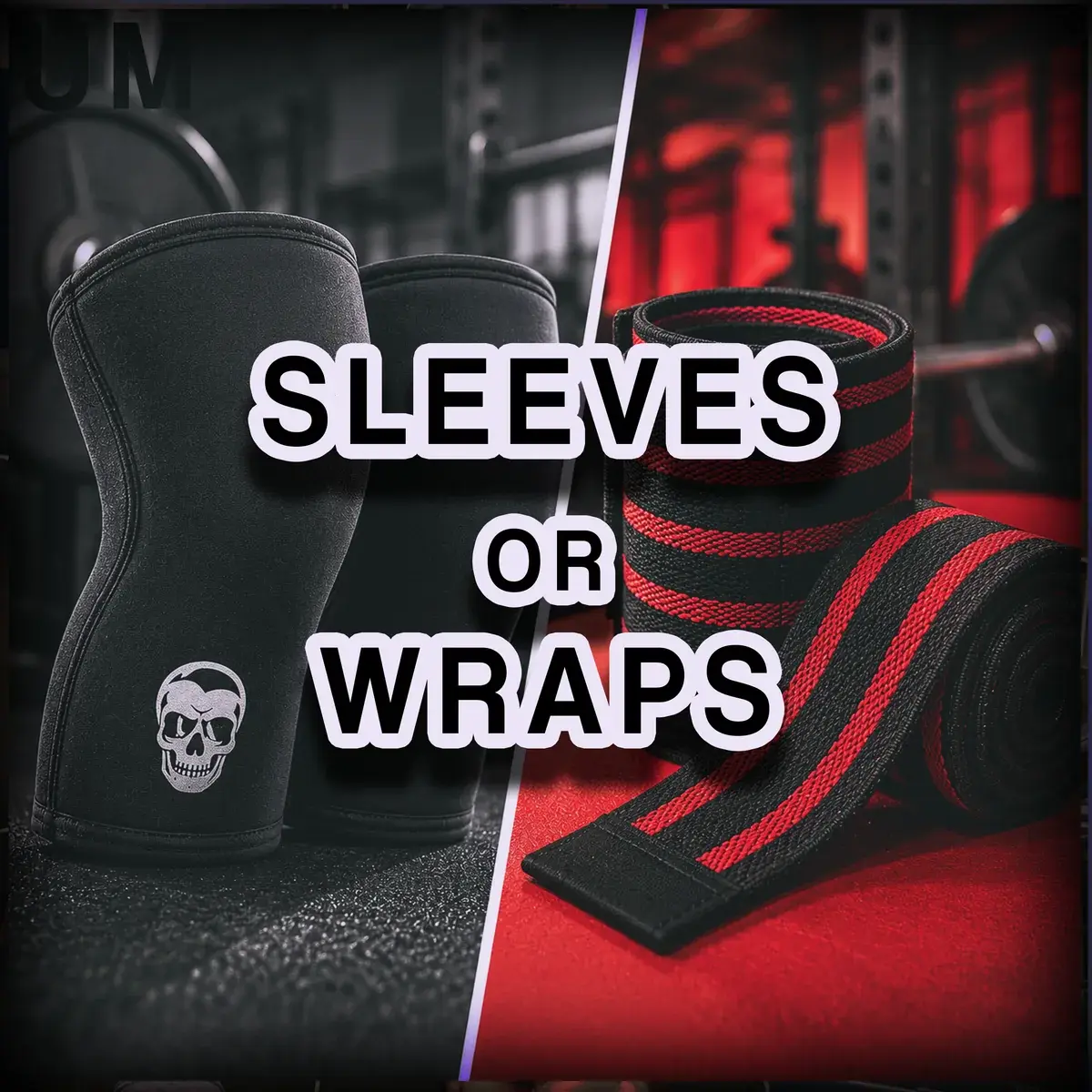
Knee sleeves are usually made from neoprene or a similar compressive material. They slide over the knee, stay in place through a session, and give you a snug layer of pressure and warmth.
That does not sound dramatic, but for a lot of lifters it is enough to make lower body training feel noticeably better.
Warmth
Warm joints usually feel better than cold joints, especially if you are training early, lifting in a colder garage gym, or doing a lot of squat volume. Sleeves help keep the area warm between sets, which can make your knees feel less stiff and less creaky as the session goes on.
That warmth is one reason sleeves are popular with people who train hard but are not chasing every last pound on a max-effort squat.
Joint comfort
A lot of lifters do not need more "support" so much as they need less irritation.
Knee sleeves can help take the edge off that achy, annoyed feeling some people get during higher-volume squats, leg presses, lunges, or hack squats. They do not fix the cause, but they can make training more tolerable when the issue is mild and manageable.
That distinction matters. If your knees feel better in sleeves, great. Just do not confuse symptom relief with solving the underlying reason your knees are irritated in the first place.
Perceived stability
Knee sleeves can make the knee feel more secure. That does not mean they are bracing the joint the way people sometimes imagine. It means the compression gives you feedback. You feel the joint more. You feel more "held together." For many lifters, that creates a stronger sense of stability even when the actual mechanical support is modest.
That feeling can be useful. Confidence changes how people move.
Confidence under load
This is the benefit people often underrate because it sounds too soft to count.
But if a piece of gear makes you feel more settled during a heavy squat, that can matter. A lifter who trusts the descent, stays tighter, and commits to the rep usually performs better than one who is tentative and distracted by knee discomfort.
That does not mean sleeves directly make you stronger. It means they can make it easier to express the strength you already have.
Training situations where sleeves make sense
Knee sleeves make the most sense for lifters who want a training tool, not a competition-specific squat enhancer.
They are a good fit for:
- general strength training
- bodybuilding leg days
- higher-volume squatting
- front squats and high-bar squats
- leg sessions where the knees just feel better with some warmth and compression
- lifters who want support without changing the lift too much
That is why sleeves have broad appeal. They are easy to live with.
Get some knee sleeves here: GymReaper Knee Sleeves
What knee wraps actually do differently
Wraps are long, stiff elastic bands that you wind tightly around the knee. When used aggressively, they create significant tension around the joint. That tension changes how the bottom of the squat feels and can help drive you back out of the hole.
That is why wraps are not just "advanced sleeves." They do something else.
They change the lift
Wraps can create rebound out of the bottom position of a squat. In other words, they can store tension and give you carryover as you reverse direction. That can help you squat more weight, which is exactly why wrapped squatting exists in certain powerlifting contexts.
But that also means the movement can feel different. Depth, timing, descent control, and setup all become more specific. You are not just putting on extra comfort gear. You are changing the way the squat behaves.
They are more specialized
Most lifters do not train in wraps because most lifters do not need a wrap-specific squat.
If your goal is general strength, muscle growth, athletic carryover, or just getting better at squatting in the gym, wraps usually add complexity without solving your real problem. They take longer to put on, can be uncomfortable, and make less sense for normal training volume.
For the lifter who competes in wraps, that tradeoff is worth it. For the average gym lifter, it usually is not.
They are less comfortable and less convenient
Knee sleeves are annoying for about five seconds while you pull them on. Knee wraps can turn every hard set into a setup ritual. Tight wraps are not something most people want to wear through a full workout, especially if the session includes a bunch of accessories or multiple lower-body movements.
So even if wraps offer more "support" in the broadest sense, that does not make them better for everyday training.
Knee sleeves vs knee wraps: what is the actual difference?
Support
Sleeves provide mild compression, warmth, and a more supported feeling.
Wraps provide much more aggressive external tension and can materially affect how the squat feels.
Carryover
Sleeves may help indirectly because you feel better and move with more confidence.
Wraps can provide actual rebound and performance carryover in the squat when used correctly.
Comfort
Sleeves win easily for comfort and all-session wear.
Wraps are much less comfortable, especially when applied tightly enough to do what people buy them for.
Ease of use
Sleeves are simple. Pull them on, train, take them off.
Wraps take setup, practice, and intention. Badly wrapped knees are either useless or miserable.
Best training context
Sleeves work well for general gym training, hypertrophy, and most non-specialized strength work.
Wraps make the most sense in powerlifting or for lifters specifically training a wrapped squat.
Best for beginners vs advanced lifters
Beginners can use sleeves if they like the feel, but they usually should not treat them like a requirement.
Beginners almost never need wraps.
Advanced lifters may use sleeves all the time. Advanced powerlifters who compete in wraps may also need wraps. Those are not the same group.
Who should buy knee sleeves?
General gym lifters
If you squat, leg press, lunge, or train legs hard more than once a week, sleeves are often the simplest helpful option. They add just enough warmth and compression to make training feel smoother without taking over the workout.
Bodybuilders
Bodybuilders often care less about max squat numbers and more about getting through productive leg volume without every set feeling rough on the joints. That is a pretty natural fit for sleeves.
If your training is heavy on squats, hack squats, split squats, or high-rep quad work, sleeves can be a comfort tool that earns its place.
People squatting for volume
This is probably one of the best use cases.
A single heavy set is one thing. Multiple hard sets over time are where sleeves often feel most useful. They help sessions feel more repeatable, especially when you are training lower body hard week after week.
Lifters with cranky knees but otherwise decent movement
If your knees are mildly irritated, you generally move well, and the issue seems more like training wear-and-tear than a serious problem, sleeves can be worth trying. They are not a cure, but they can be a useful layer of comfort while you clean up the bigger picture.
Who should buy knee wraps?
Get wraps here: GymReaper Knee Wraps
This list is much shorter.
Powerlifters
If you compete in a federation or division where wraps are relevant, then wraps make sense because the sport makes them relevant. At that point, you are not deciding between comfort tools. You are deciding how to train the version of the lift that matters on the platform.
People specifically training with wraps
Some lifters are not competing yet but are still intentionally training a wrapped squat. That can make sense if the goal is clearly strength sport performance and they understand the technique tradeoff.
Lifters who understand the tradeoff
Wraps suit lifters who want the carryover enough to accept the extra setup, a different squat feel, and more specialized training.
Who probably needs neither yet?
A lot of newer lifters do not need sleeves or wraps. They need more consistent technique, better bracing, better exercise selection, and a training load that matches what their body can currently tolerate.
You probably do not need either one yet if:
- your squat pattern still changes every session
- you are adding load faster than your form can support
- your knees only hurt when fatigue gets sloppy
- your recovery habits are all over the place
- you are mostly buying gear because it feels like the "serious lifter" move
There is nothing wrong with wanting good gear. Just make sure you are not using equipment to skip basic training progress.
When knee pain is not a gear problem
Knee sleeves can make discomfort feel more manageable. Knee wraps can make a squat feel more supported. Neither one automatically fixes why your knees are unhappy.
Load management issues
Sometimes the simplest answer is the right one. You are doing too much, too soon, too often.
That might mean your squat frequency is too high, your intensity is creeping up while fatigue is already high, or your total lower-body volume has outpaced what you can recover from.
No sleeve or wrap fixes that.
Poor exercise selection
Not every lifter tolerates the same squat pattern equally well.
Some people do better with a high-bar squat than a low-bar squat. Some feel better with a box squat, safety bar squat, split squat, or leg press for a while. Some lifters keep forcing one variation that irritates their knees when a small exercise change would calm things down quickly.
That is not a gear issue. That is a programming issue.
Technique breakdown
If your knees cave, your balance shifts badly, your descent is uncontrolled, or you keep changing stance and depth from set to set, support gear is not the first fix.
Better positioning, better bracing, and more repeatable reps usually matter more.
Recovery and mobility limitations
Sometimes the reason your knees feel awful has less to do with the knee itself and more to do with the rest of the system.
You may be under-recovered. Your sleep may be poor. Your training week may be too dense. Your ankles or hips may be limiting how cleanly you can squat. You may also be trying to progress while your nutrition is not supporting the workload.
That is why support gear only goes so far. If the inputs are off, the knee often ends up paying for it.
If your knees feel beat up all the time, check whether your recovery and nutrition are even matching your training load. Use your calorie and protein calculators to see whether you are actually eating enough to recover, and use your bodyweight or macro planning tools to see whether aggressive weight changes might be affecting training comfort and recovery.
And if pain is sharp, persistent, worsening, or comes with swelling or instability, that is your sign to stop treating it like a gear decision and get it looked at properly.
How to choose the right option
If you are leaning toward sleeves, the buying decision is pretty straightforward once you know what to look for.
Thickness
For most lifters, thickness comes down to how much structure you want.
5mm sleeves usually make the most sense for general training. They are easier to move in, more comfortable across longer sessions, and versatile enough for mixed workouts.
7mm sleeves are more common for heavier squat-focused training. They feel stiffer and more substantial, which some lifters prefer when the goal is heavier sets and more compression.
If you only want one pair and you are not a very squat-specific lifter, 5mm is often the safer all-around pick.
Material feel
Some sleeves feel softer and easier to train in for a full session. Others feel stiffer and more rigid.
Neither is automatically better. Softer sleeves tend to be easier for general use. Stiffer sleeves tend to feel more supportive but can also feel more restrictive. The best choice depends on whether you care more about comfort or structure.
Stiffness
A sleeve can fit tightly without feeling particularly stable if the material itself is soft. A stiffer sleeve may feel more "locked in," but that can come at the cost of comfort, especially during longer leg days or movements with more knee bend.
Fit and sizing
A good sleeve should feel snug, not punishing.
You want enough compression that it stays in place and gives noticeable support, but not so much that putting it on feels like a wrestling match every set. A lot of people buy sleeves too small because they assume tighter automatically means better.
Usually it just means more annoyance.
Comfort for long sessions
Ask yourself a simple question: do you want something for one top set, or something you can wear through most of leg day?
That answer should influence your choice. Sleeves that are slightly less aggressive often get worn more consistently, which makes them more useful in actual training.
Ease of taking them on and off
If a pair of sleeves is so tight that you dread taking them off between movements, they may not be the right pair for your normal training. The best support gear is the gear you will actually use as intended.
If you are considering wraps, the bigger question is even simpler: are you training for a wrapped squat on purpose? If not, you probably do not need to overthink wraps.
Common buying mistakes
Buying wraps because they sound more hardcore
This is probably the most common mistake.
Wraps look serious. They feel serious. They are associated with big squats. None of that means they are the right tool for your training.
Buying sleeves too tight
A sleeve should be snug enough to matter, not so tight that you hate wearing it.
If circulation feels cut off and every workout turns into a battle just to get them on, you went too far.
Using support gear to ignore pain signals
Support gear should help you train better, not help you pretend something is fine when it clearly is not.
If your knees are getting worse, gear is not your answer. Start with the cranky knees guide instead.
Assuming gear will fix bad squat mechanics
This is the fastest way to waste money and stay frustrated.
If your squat pattern is the issue, you will get more from better coaching, better programming, and better recovery than from any piece of knee gear.
Bottom line
Best choice for most gym lifters: knee sleeves.
They help with warmth, comfort, perceived stability, and confidence without turning squats into a wrap-specific skill.
Best choice for competitive strength athletes who train that way: knee wraps.
They can change the lift and provide carryover, but they make sense mostly when that tradeoff is part of the goal.
Who should save their money for now: beginners, inconsistent lifters, and anyone trying to solve a recovery, technique, or programming problem with gear.
FAQ
Do knee sleeves make you stronger?
Not directly in the way people usually mean it. Knee sleeves do not create the same kind of rebound that wraps can. What they can do is improve comfort, warmth, and confidence, which may help you perform better under load.
Are knee wraps cheating?
In powerlifting contexts where wraps are allowed, no. They are part of that division and the lifter is playing by the rules of that setup. But they do provide carryover, which is exactly why wrapped and raw lifting are treated differently.
Should beginners use knee sleeves?
Beginners can use sleeves if they like the feel, especially for comfort during leg training. They usually do not need them, though, and they almost never need wraps. Early on, technique, consistency, and sensible loading matter more.
What thickness knee sleeves should I buy?
For most general gym lifters, 5mm sleeves are the easiest all-around choice. If your training is more squat-heavy and you want a stiffer, more substantial feel, 7mm sleeves may make more sense.
Can knee sleeves help with knee pain?
They can help with mild discomfort by improving warmth and making the joint feel more comfortable during training. They do not fix the underlying cause of pain. If symptoms are persistent, worsening, or sharp, that needs more than a sleeve.
If your knees feel beat up every week, do not assume the answer is better gear. Check whether your recovery actually matches your training.
Use the Gym Daze calorie calculator for lifters and protein intake calculator for muscle growth to see whether you are eating enough to recover, and use your macro or bodyweight planning tools to check whether aggressive bulking or cutting is making lower-body training harder than it needs to be.