
On this page
- Do you even need lifting straps?
- How I rated these picks
- The picks that make the most sense
- Best lifting straps for bodybuilding: Harbinger Big Grip Padded Lifting Straps
- Best lifting straps for Olympic lifting: Gymreapers Olympic Lifting Straps
- Best lifting straps for powerlifting training: IronMind Strong-Enough Lifting Straps
- Best first pair for most people: Harbinger Padded Cotton Lifting Straps
- Which strap style fits which kind of lifting?
- What actually matters when buying straps?
- Grip security
- Material and durability
- Comfort on the wrist
- Ease of setup and release
- Versatility
- When lifting straps make sense
- When you should not use straps
- Straps vs other grip tools
- Straps vs chalk
- Straps vs hooks
- Straps vs Versa Gripps-style attachments
- How to use lifting straps correctly
- Common mistakes people make with straps
- FAQ
- Do lifting straps weaken your grip?
- Are Olympic lifting straps better than regular straps?
- Should beginners use lifting straps?
- Can you use straps in powerlifting?
- What is the best strap style for bodybuilding?
Not sure which lifting straps to buy? Here's a practical guide to the best lifting straps for bodybuilding, Olympic lifting, powerlifting training, and general gym use, plus when to use them and when to skip them.
Most people do not need lifting straps on every pulling set. They help when your hands fail before the muscles you are trying to train on deadlifts, rows, shrugs, pulldowns, or other pulling variations. If you are comparing repeatable deadlift sets, the 1 Rep Max Calculator can help separate stronger pulling from a better day for your grip.
For most lifters, the best first pair is still a simple padded lasso strap. Once your training gets more specific, the best choice changes. Bodybuilding tends to reward comfort and grip security across a lot of volume. Olympic lifting rewards fast setup and fast release. Powerlifting training rewards durability and a more locked-in wrap for heavy pulls.
Do you even need lifting straps?
Straps are optional, but can help in the right situation.
You probably benefit from straps if your hands are giving out before your back, hamstrings, or traps are actually challenged. That is common on deadlifts, Romanian deadlifts, rows, pulldowns, shrugs, snatch pulls, clean pulls, and long back-off sets. Used that way, straps keep the set focused on the target muscles instead of turning every hard pull into a grip test.
You should probably skip them for now if all of your pulling is still light, you are still learning bar position and setup, or grip strength itself is a weak point. Choose when to use them rather than putting them on by default.
How I rated these picks
To keep this simple and consistent, I am using five criteria:
- Grip security: how well the strap stays locked to the bar once wrapped
- Comfort: how much wrist pressure or digging you get during repeated sets
- Versatility: how many different pulling movements the strap handles well
- Durability: how well the materials and construction should hold up over time
- Setup and release: how quickly you can get in and out of the strap
Those criteria do not matter equally for every lifter.
For bodybuilding, comfort and repeatability matter more because you may use straps on rows, pulldowns, shrugs, and multiple back exercises in one session. For Olympic lifting, setup speed and release matter more because the strap has to work with pulls and dynamic bar path, not fight it. For powerlifting training, grip security and durability rise to the top because the strap has to stay dependable under very heavy deadlift work.
The picks that make the most sense
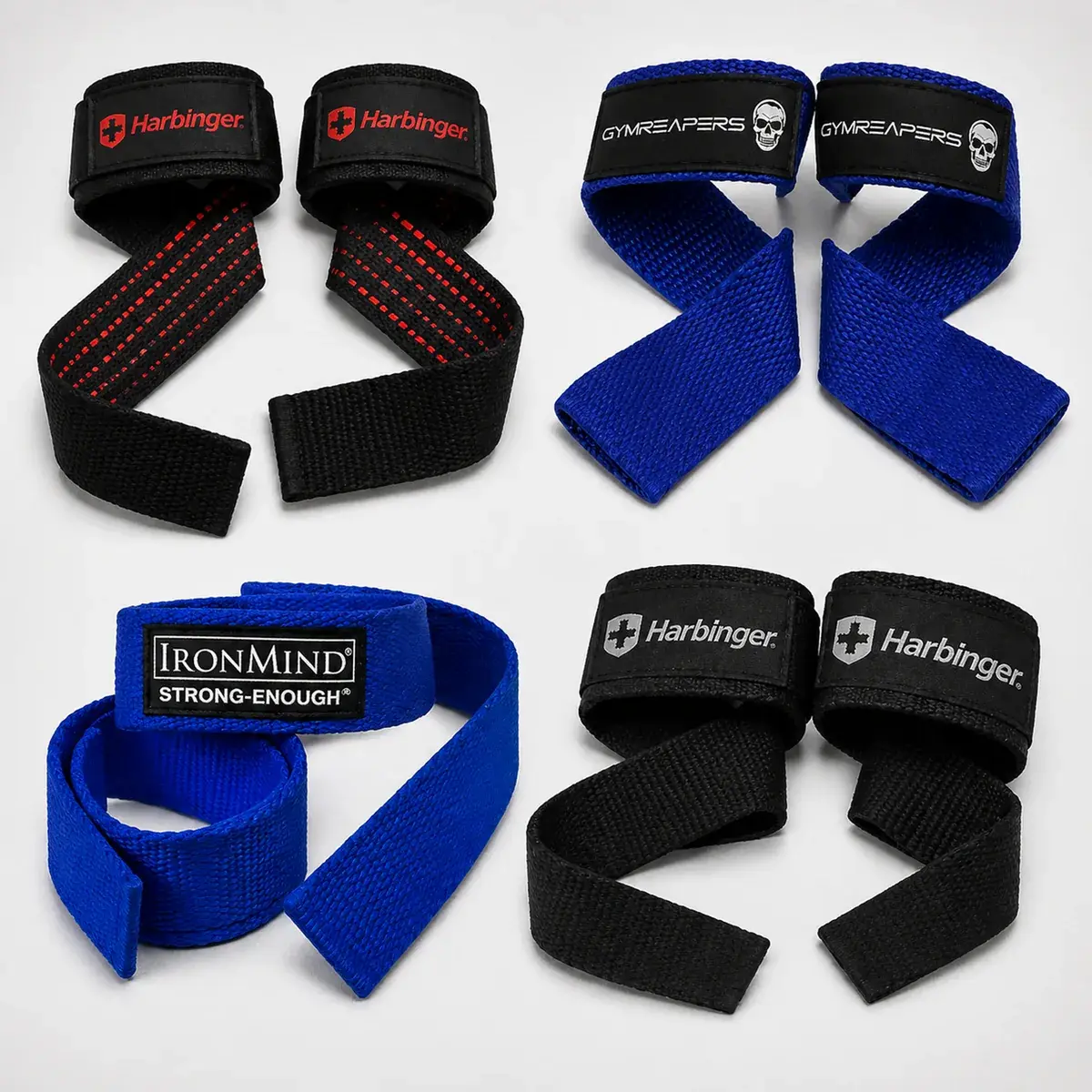
Best lifting straps for bodybuilding: Harbinger Big Grip Padded Lifting Straps
This is the bodybuilding pick because the design is aimed right at the two things that matter most on high-volume back work, comfort and bar security. Harbinger says the Big Grip uses durable nylon, rubber grip strips for a no-slip hold, NeoTek wrist padding, and merrowed end tabs to limit fraying. That combination makes sense for rows, pulldowns, dumbbell pulling, machine work, and shrug variations where you want a secure wrap without your wrists getting chewed up over multiple sets.
Why it wins this category:
- The rubberized grip surface is the most category-specific feature of any strap here
- The padding matters more on high-volume hypertrophy work than it does on a single top set
- It still behaves like a normal lasso strap, so it does not become annoying outside of one lift
Where it falls short is versatility. This is still a strong general strap, but the "no-slip" design is more useful for bodybuilding and back-day volume than it is for Olympic pulling or minimalist deadlift training.
Best lifting straps for Olympic lifting: Gymreapers Olympic Lifting Straps
Olympic lifting straps need a different balance. They have to give you enough connection to the bar without turning the setup into a slow, overbuilt mess. Gymreapers' Olympic Lifting Straps use a teardrop design, reinforced triple stitching, soft cotton fabric, and an 8.5-inch strap length, which is much shorter than the typical long lasso strap. That shorter design is why this is the better fit for snatch pulls, clean pulls, hang work, and other Olympic-style pulling variations.
Why it wins this category:
- Shorter length improves setup speed and release
- The design is purpose-built for cleans, snatches, and Olympic pulling
- Cotton keeps it simpler and less bulky at the wrist
The tradeoff is less grip security for very heavy general deadlifting.
Best lifting straps for powerlifting training: IronMind Strong-Enough Lifting Straps
This is the powerlifting training pick, not because straps are competition gear, but because powerlifters often want straps for top deadlift sets, overload work, high-volume pulling blocks, and accessory movements where grip would otherwise cap the training effect. The Strong-Enough straps are 21.25 inches long, 1.5 inches wide, made from nylon webbing, and positioned by IronMind as a heavy-duty general-purpose strap. This model became the top pro strongman choice and is the single best catch-all lifting strap for most people. (IronMind Store)
Why it wins this category:
- Long wrap and nylon construction prioritize security and durability
- It makes the most sense when heavy deadlifts are the main event
- It is built around repeatable heavy pulling, not just gym comfort
The downside is comfort. This is more of a serious pulling strap than a plush back-day strap. If wrist comfort is your top priority, this is probably not where I would start.
It is also worth being clear about the powerlifting part. In meet settings, USA Powerlifting rule language covers approved competition apparel and equipment like singlets, shirts, suits, belts, sleeves, wraps, and footwear, which is why lifting straps are best thought of as a training tool rather than platform gear.
Best first pair for most people: Harbinger Padded Cotton Lifting Straps
If someone is just getting their first pair and is not really a bodybuilder, Olympic lifter, or powerlifter specifically, this is the one I would hand them first. Amazon's Harbinger listing describes the Padded Cotton Lift Straps as 21.5 inches long and 1.5 inches wide, with NeoTek wrist cushioning. Those are very beginner-friendly dimensions because the strap is long enough to get a secure wrap, wide enough to spread pressure better across the wrist, and padded enough that a new user is less likely to hate how it feels on day one.
This is the best first-buy pick because it scores well across every category without being too specialized:
- comfortable enough for regular gym use
- versatile enough for deadlifts, rows, pulldowns, and shrugs
- secure enough for most lifters who are not chasing extreme loads
- simple enough to learn without frustration
For a first pair, ease of learning matters more than having the most specialized strap.
Which strap style fits which kind of lifting?
- A standard lasso strap is the best default for most people because it is versatile enough for deadlifts, RDLs, rows, pulldowns, shrugs, and general gym training.
- A short Olympic-style strap is better when fast setup and fast release matter (i.e. Olympic lifts).
- A more aggressive heavy-duty lasso or strongman-style strap is better when the whole point is locking onto a very heavy bar and you can sacrifice comfort
That is also why I would not push figure 8 straps as the main recommendation for most readers. They can be great for very heavy deadlifts, but they are more specialized and less adaptable across the rest of normal training. The average lifter does better with a normal strap first.
What actually matters when buying straps?
Grip security
This is still number one. If the strap wraps inconsistently or slips on the bar, it does not matter how comfortable it is. Longer straps usually improve security. Rubberized grip surfaces can also help, especially when your training is more bodybuilding-oriented.
Material and durability
Cotton usually feels simpler and more forgiving. Nylon usually feels more built for hard pulling. That is why a cotton Olympic strap and a nylon heavy deadlift strap solve two different problems. Gymreapers uses cotton for both its Olympic and standard padded straps, while IronMind's Strong-Enough model uses blue nylon webbing.
Comfort on the wrist
This matters a lot more than people admit. Wrist padding sounds minor until you do heavy rows after deadlifts or use straps across an entire back workout. Harbinger's padded models and Gymreapers' neoprene-padded general straps are built around this exact issue.
Ease of setup and release
This matters most for Olympic lifting, but it still matters in normal gym training too. If a strap is secure but slow and annoying, you will use it less often, or use it inconsistently.
Versatility
This is where the first-buy recommendation usually lives. A good first strap should not be perfect for one narrow task. It should be good enough across several pulling movements, hence my earlier recommendation of the Habringer Padded Cotton Lifting Straps
When lifting straps make sense
The best time to use straps is when grip is limiting the set more than the target muscles are.
That usually means:
- deadlifts and Romanian deadlifts
- rows
- pulldowns
- shrugs
- snatch pulls and clean pulls
- high-rep back work
Straps are useful when they help the intended training effect happen, and less useful when they start replacing grip work that you still need.
When you should not use straps
Do not use them on every pulling set by default.
That is the fastest way to let your grip fall behind.
You should also skip them for:
- lighter warm-up sets
- dedicated grip training
- technical work where you are still learning the hand-bar relationship
- exercises where the grip setup is more annoying than helpful
- any set where your grip is supposed to be part of the training effect
Decide whether grip is part of what you want to train or a limit you want to work around.
Straps vs other grip tools
Straps vs chalk
For most people, chalk comes first.
Chalk is cheaper, simpler, and faster. It improves your hold on the bar without taking grip out of the lift. If your only problem is sweaty hands or a slightly insecure grip, chalk is usually the smarter first fix.
Straps vs hooks
Hooks are quicker to use, but they are bulkier and usually feel less connected to the bar. They can work, especially if convenience is everything, but most lifters who care about natural bar feel end up preferring straps.
Straps vs Versa Gripps-style attachments
These solve a slightly different problem. They are faster to use and often popular for bodybuilding-style training, but they cost more and are less necessary if all you really want is a solid pulling strap for rows and deadlifts. For most people, chalk first and a normal lasso strap second is still the cleaner path.
How to use lifting straps correctly
The basic setup is simple once you do it a few times.
- Thread the tail through the loop to create the wrist opening.
- Wear them the same way every session so the wrap direction stays consistent.
- Set the bar lower in the fingers, not jammed high into the palm.
- Wrap one strap around the bar, roll the bar to tighten, then wrap the other side.
- Tighten enough to stop bar roll, but not so much that your wrist position gets ugly.
- Release in control after the set instead of yanking out blindly.
Common mistakes people make with straps
These are the ones I see most often in articles on the topic, and they are still the ones that matter most in practice:
- using them too early in the workout
- depending on them for all pulling
- buying a highly specialized strap as a first pair
- wrapping them differently every set
- ignoring grip training completely
Keep training your grip when you use straps.
FAQ
Do lifting straps weaken your grip?
Not automatically. They only become a problem if you use them on every pulling movement and never train your grip directly. Used selectively, they let you keep grip from limiting movements that are supposed to challenge your back, traps, or posterior chain.
Are Olympic lifting straps better than regular straps?
Only for Olympic-style training. A short Olympic strap is better when fast release matters. A regular lasso strap is better for general gym use because it is more versatile.
Should beginners use lifting straps?
Sometimes, yes. But beginners usually do better with a simple padded lasso strap and selective use, not automatic use on every pulling set.
Can you use straps in powerlifting?
In training, yes. In competition, think of them as a non-meet tool. Current USA Powerlifting rulebook language lays out approved competition apparel and equipment categories, which is why straps belong in training tools rather than automatically on the platform.
What is the best strap style for bodybuilding?
Usually a padded lasso strap, especially one with a more secure grip surface. Bodybuilding work rewards comfort, consistency, and time under tension more than ultra-specialized deadlift lock-in.
If you are overthinking this, keep it simple. Buy one good first pair, use it on the hard pulling sets where grip is not the point, and keep training your hands too. That approach gets you most of the benefit without turning straps into a crutch.