
On this page
This workout uses long-loop resistance bands and clear floor space. There are seven exercises, two working sets of each, with both legs trained separately on the reverse lunges. The video takes just under thirty minutes, including the warm-up and rests. You can pause whenever you need longer.
My gym was closed, so this is the session I did at home. You don't need a door anchor or a rack. A mat is optional for the floor exercises, and having a lighter band nearby makes the changes between exercises easier.
Choose bands that make your sets difficult
Use a band that makes the last few reps challenging while you can still control the movement. In the recorded workout, most band sets are about ten reps and the butt-ups are fifteen. Your band color doesn't need to match mine. Colors and resistance vary between products, and the same band won't suit every exercise.
Check the bands for damage and make sure the contact under your feet or hands stays secure. Keep them clear of sharp edges and follow the manufacturer's stretch limits. Take the tension off before changing your grip or moving the band to the other foot.
For push-ups, you may not need the band at all. If ordinary push-ups are difficult, start there or use an easier version. Use less resistance when you can't control the movement.
The band guide explains the equipment types. This session uses long loops; a small hip band isn't interchangeable with that setup.
The workout in order
The video starts with a warm-up at 0:27. Follow the easy movements, check the band setup and take more preparation time if you need it. The working exercise chapters start here:
| Exercise | Working sets | Rest guide | Video chapter |
|---|---|---|---|
| Band reverse lunges | 2 per leg | 90 seconds between rounds | 4:00 |
| Banded push-ups | 2 | 90 seconds | 9:34 |
| Bent-over two-arm band rows | 2 | 90 seconds | 14:26 |
| Band side-delt raises | 2 | 60 seconds | 17:26 |
| Band skull crushers | 2, paired with curls | 60 seconds after the pair | 20:26 |
| Band biceps curls | 2, paired with skull crushers | Same paired rest | 22:00 |
| Butt-ups | 2 | 60 seconds | 25:27 |
The arm section alternates skull crushers and curls. Finish one set of each, take the longer rest, then repeat the pair. It isn't two skull-crusher sets followed by two curl sets.
The chapter time marks the section's introduction or setup. Leave time for that preparation, and use the recovery and demonstrations between sets too.
Lunges, push-ups and rows
On the reverse lunge, the front foot stays planted on the band. Step the other leg back, lower under control and drive through the front foot to stand. Finish that side before unloading the band and changing legs. Two sets per leg means each leg gets two working sets, not one set each.
If the band makes balance difficult, remove it. You can also practice a stationary split squat if stepping back is the part you can't control. Keep a little width between the feet so you're not trying to balance on a tightrope.
For push-ups, keep the band across the upper back and secured beneath the hands, away from the neck. Lower the chest and hips together. Remove the band or use a knees-down version if you can't keep that position.
For rows, stand securely on the band, soften the knees and hinge forward. Keep your torso still as you pull toward the lower ribs. In the video I show how I grip both strands of the loop for this setup. Choose a grip and band length that let you finish the pull without the band slipping. Stand up and unload it during the rest.
If the row angle is unfamiliar, the back-training guide explains the movement and other home options.
Shoulders, arms and the final ab exercise
Side-delt raises usually need less resistance than rows. Raise the arms smoothly and lower them under control. If you need to throw your torso into every rep, use a lighter band. You can see more options in the home shoulder guide.
For the floor skull crusher, keep the band secured beneath the upper back and bend and straighten the elbows. Unload it before standing up for curls. With the band under your feet, curl without swinging the upper arms or hips to finish the rep. You can use different bands for the two exercises.
The butt-up finishes the session. Lie on your back with the legs raised, then curl the pelvis a short distance off the floor and lower it under control. Bend the knees or shorten the movement if needed. The aim is a controlled pelvic curl; swinging the legs to throw the hips upward changes what you're doing.
Pause if the next set would be rushed
The rests in the table are guides. If you're still struggling to get into position or need more recovery, pause the video. You don't get a bonus for finishing faster.
Choose the resistance by the reps you can perform with control and how hard those reps feel. Stop when you've completed your planned reps, even if I'm still moving on screen.
This is one session to fit into a weekly routine. It covers several major muscle groups, but it doesn't contain every movement you might want in your program. For example, the leg section is lunge-focused and doesn't include a dedicated hip hinge.
The ACSM's 2026 guidance supports bands and home resistance training as useful options. It doesn't validate this particular sequence or mean you should repeat all seven exercises every day. Account for your other training and recovery when deciding where the session belongs.
Record enough to repeat it
Write down the band, grip, foot position and reps for each exercise. A note like “blue band” is only useful if you know which blue band and how you used it.
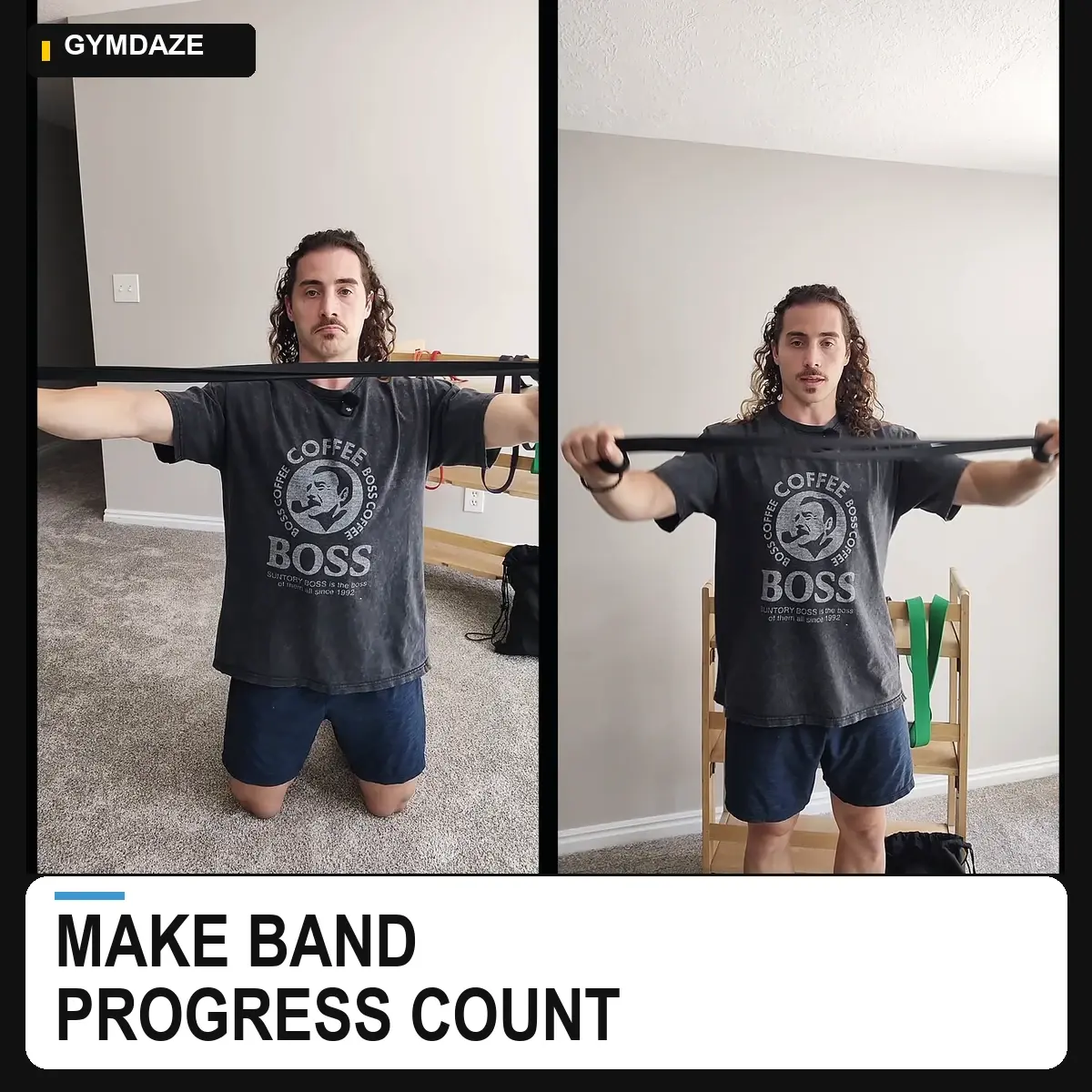
The band-progress guide shows how to record those details and when to increase the resistance.
Next time, repeat that setup and compare the work. As the same reps become easier with control, make a small increase in resistance. If the heavier band shortens the range or makes you rush, use a smaller change. Save the video so you can return to the same session, or use the exercise list to run it at your own pace.
Common questions
Frequently asked questions
Do I need an anchor for this band workout?
No. The session uses long-loop bands secured by your hands, feet or upper back, plus floor space. Check that each contact stays secure, inspect the bands and follow their manufacturer's stretch limits.
References