
On this page
- What you need (and what is optional)
- Required
- Helpful but optional
- The simple weekly schedule
- How to place rest days
- Warm up that takes 5 minutes
- Joint prep that matters for dumbbells (2 minutes)
- First set ramp up method (1 minute)
- The workout
- Day 1 Full Body A
- Accessories
- Optional finisher (5 minutes)
- Day 2 Full Body B
- Accessories
- Optional finisher (6–8 minutes)
- Day 3 Full Body C
- Accessories
- Optional finisher (5 minutes)
- Exercise substitutions if you are missing equipment
- No pull up bar substitutions
- No room for certain moves substitutions
- If something hurts, swap it rules
- How to choose starting weights
- The rep range target
- How to use reps in reserve without overthinking it
- What to do if you picked too heavy or too light
- Progression plan for the next 4 weeks
- Week 1 baseline
- Week 2 add reps
- Week 3 add weight
- Week 4 deload or repeat
- When to increase weight vs increase reps
- Form cues that prevent beginner mistakes
- Bracing and rib position
- Shoulder position and pressing
- Hinge vs squat difference
- Rowing without using momentum
- Common beginner mistakes and how to fix them
- Doing too many exercises
- Training to failure too often
- Changing the plan every week
- Skipping legs because dumbbells feel awkward
- Not tracking anything
- How to pair this with fat loss or muscle gain
- Protein target rule of thumb
- Steps and cardio guidelines that do not interfere
- Where adjustable dumbbells fit in
- What weight range you will eventually want
- When it is time to upgrade
- FAQs
- Is 3 days enough to build muscle?
- Can I do this 4 days per week?
- What if I only have light dumbbells?
- How long should workouts take?
- What should I eat before and after?
- Next steps
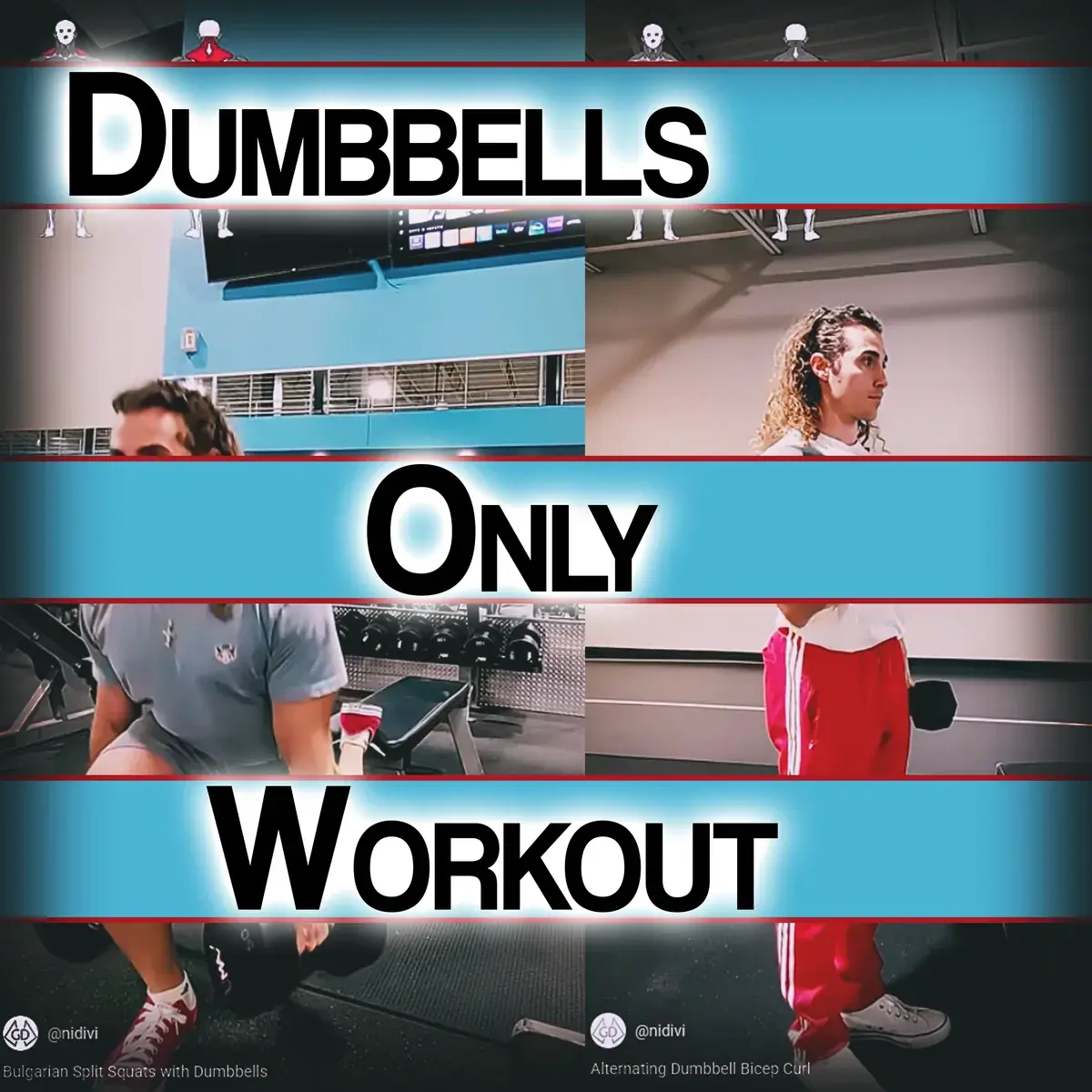
This dumbbell-only full-body workout gives beginners a way to train at home without long sessions or a gym membership.
You'll train 3 days per week and work every major muscle group multiple times. The movements use dumbbells, and the progression plan gives you something consistent to follow even when motivation varies. What this program is and why it works
This is a 3-day per week full body plan using dumbbells as the main tool. Each day focuses on the same big movement patterns (squat, hinge, push, pull, carry/core), but with slightly different exercises or angles so you get:
- enough weekly volume to build muscle and strength
- enough recovery to keep your joints happy
- enough repetition to learn good form fast
Beginner programs often fail because they are inconsistent, random, or too complicated, rather than too easy. This plan keeps the exercise menu small and the progression simple.
Choose exercises you can repeat, track, and improve without worrying about a perfect selection. Who this is for and what results to expect
This is for you if:
- you're new to lifting, or coming back after a long break
- you only have dumbbells (or want a home plan that doesn't depend on machines)
- you want muscle, strength, and better conditioning without living in the gym
- you want something structured but not overwhelming
What results to expect (if you train consistently and eat like a normal adult who wants results):
- noticeable strength gains in 2–4 weeks (especially on presses, rows, squats)
- better muscle tone and posture within a month
- improved work capacity (you'll feel less "gassed" during sets)
- steady progress you can actually measure
If your goal is fat loss, you'll feel tighter and more athletic quickly, but scale changes depend mostly on diet. We'll cover that later.
What you need (and what is optional)
Required
- a pair of dumbbells (adjustable is ideal, but not mandatory)
- For my selection of home dumbbells, check out my Dumbbell blog post here --> Best Dumbbells
- a timer (phone is fine)
- a notebook/app to track workouts
Helpful but optional
- a bench (or a sturdy chair/couch edge)
- a pull-up bar (nice, but not required)
- a mat (for floor work)
- lifting straps (only if your grip becomes the limiting factor on rows or RDLs) --> Lifting Straps
If you only have one pair of dumbbells, you can still run this. You'll just use more reps, slower tempos, and single-leg versions to make lighter weight challenging.
The simple weekly schedule
You'll do three full body sessions. Keep at least one day between them when possible.
A simple setup looks like:
- Monday: Day 1
- Wednesday: Day 2
- Friday: Day 3
Day 1
Full Body A (squat emphasis + horizontal push/pull) Day 2
Full Body B (hinge emphasis + vertical-ish push/pull options) Day 3
Full Body C (single-leg emphasis + mixed angles)
How to place rest days
The rule: avoid lifting 3 days to allow for maximal stimulation and recovery timing
Good options:
- Mon/Wed/Fri (best)
- Tue/Thu/Sat (also great)
- Mon/Thu/Sat (if your week is chaotic)
If you miss a day, don't "double up" to catch up. Just do the next workout the next time you train.
Warm up that takes 5 minutes
Warm-ups should make you feel ready, not exhausted. General warm-up options (2 minutes)
Pick one:
- brisk walk in place
- jumping jacks
- light bodyweight squats
- stair walking
- easy high knees
- stationary bike
You should feel warmer and a little out of breath, but still able to talk.
Joint prep that matters for dumbbells (2 minutes)
Do one round:
- 8 bodyweight hinges (hands on hips, push hips back)
- 8 slow shoulder circles each direction
- 8 scapular push-ups (on knees if needed)
- 8 reverse lunges (bodyweight)
First set ramp up method (1 minute)
For your first main lift of a body part:
- do at least 1 easy set of 8 reps with a lighter weight
- then your first "real" working set
This makes your first working set feel smoother and reduces the odds of tweaking something cold.
The workout
A few quick rules before the day-by-day plan:
- Rest at least 60-120 seconds between sets for main lifts.
- Rest at least 45-90 seconds for accessories.
- You need to get close to failure on your sets (no more than 1-2 reps in reserve).
- If a rep range says 6-10 that means you should use a weight that takes you close to failure in that rep range - not just stopping somewhere in that range
- Your goal is clean reps, not survival.
Day 1 Full Body A
Main lifts
- 3 sets of 6–10 reps
- Cues: elbows inside knees, stay tall, control the bottom.
- (or bench press if you have a bench)
- 3 sets of 6–10 reps
- Cues: wrists stacked, slight pause on the floor, drive up smoothly.
- One-Arm Dumbbell Row
- 3 sets of 8–12 reps each side
- Cues: pull elbow toward hip, don't twist your torso.
Accessories
- 2–3 sets of 8–12 reps
- Cues: hips back, soft knees, feel hamstrings stretch.
- 2 sets of 12–20 reps
- Cues: raise to shoulder height, slow down, don't swing.
- Front Plank
- 2 sets of 30–60 seconds
- Cues: ribs down, glutes tight, breathe quietly.
Optional finisher (5 minutes)
- 5 rounds: 20 seconds farmer carry march in place + 40 seconds easy rest
- If you don't have space to carry, just stand tall holding heavy dumbbells and march.
Day 2 Full Body B
Main lifts
- 3 sets of 6–10 reps
- This is your "strength hinge" day. Make it controlled and consistent.
- Standing Dumbbell Overhead Press
- 3 sets of 6–10 reps
- Cues: squeeze glutes, ribs down, press slightly back, don't flare.
- Chest-Supported Dumbbell Row (bench)
- 3 sets of 8–12 reps
- Cues: pause at the top, don't bounce.
Accessories
- 2–3 sets of 8–12 reps each leg
- Cues: step back, front foot planted, torso upright.
- 2 sets of 10–15 reps
- Cues: elbows near sides, full range.
- Overhead Triceps Extension (one DB)
- 2 sets of 10–15 reps
- Cues: keep elbows pointed forward, slow lowering.
Optional finisher (6–8 minutes)
- 6–8 minutes easy pace: step-ups, incline walk, or marching
- Keep it light. You should finish feeling better, not destroyed.
Day 3 Full Body C
Main lifts
- Split Squat (rear foot on floor)
- 3 sets of 8–12 reps each leg
- Cues: front heel heavy, knee tracks over toes, stay tall.
- Incline Dumbbell Press (bench) or Push-Up (hands elevated if needed)
- 3 sets of 6–12 reps
- If push-ups are too hard, elevate hands on a couch or sturdy counter.
- One-Arm Row (Staggered Stance)
- 3 sets of 8–12 reps each side
- Use a slightly different setup than Day 1, like bracing on a chair or elbow on your knee.
Accessories
- Dumbbell Hip Thrust or Glute Bridge
- 2–3 sets of 10–15 reps
- Cues: tuck ribs, squeeze glutes hard at top.
- Rear Delt Fly (hinge position)
- 2 sets of 12–20 reps
- Cues: small bend in elbows, think "wide," not "up."
- Suitcase Carry (one dumbbell)
- 2 sets of 30–60 seconds each side
- Cues: don't lean, walk slow and tall.
Optional finisher (5 minutes)
- 10 rounds: 15 seconds bodyweight squats + 15 seconds rest
- Keep it smooth. This is for conditioning, not punishment.
Exercise substitutions if you are missing equipment
This is where dumbbell-only plans get easier. You can swap without breaking the program as long as you keep the same movement pattern. No bench substitutions
- Bench press → floor press or push-ups
- Incline press → feet-elevated push-ups or hands-elevated push-ups with slow tempo
- Chest-supported row → hinged two-arm row or one-arm row
No pull up bar substitutions
You don't need one, but if your plan had pull-ups in the future:
- Pull-ups → one-arm rows, two-arm rows, dumbbell pullovers
- If you eventually get a bar, awesome. But rows and pullovers will still build your back.
No room for certain moves substitutions
- Farmer carries → march in place holding dumbbells
- Suitcase carry → single-arm hold + slow march
- Step-ups → reverse lunges or split squats
If something hurts, swap it rules
- Sharp pain: stop and swap immediately.
- Joint pain that builds each rep: swap.
- Muscle burn and normal fatigue: keep going.
Swap within the same category:
- squat pattern (goblet squat ↔ overhead squat ↔ pistol squats)
- hinge pattern (RDL ↔ single-leg RDL ↔ glute bridge ↔ hip thrust)
- press pattern (floor press ↔ push-up ↔ incline press ↔ shoulder press ↔ chest flyes)
- row pattern (one-arm row ↔ two-arm row ↔ chest-supported row)
If a movement always hurts even with lighter weight and good form, skip it and pick a pain-free alternative.
How to choose starting weights
Beginners mess this up both ways. Either they go too light and it's basically cardio, or too heavy and every set looks like a car crash.
The rep range target
Most sets for this workout are in:
- 6–10 reps for main lifts
- 8–12 reps for main pulls/legs
- 10–20 reps for small accessory work
How to use reps in reserve without overthinking it
Reps in reserve (RIR) is simple.
If you want the full explanation before using it in this plan, read how close to failure you should train.
- For most sets, finish with about 2 reps left.
- That means you could do 2 more reps before failure if you had to.
- You're not guessing perfectly. You're aiming for "challenging but clean."
- Pro tip: find your actual failure first so you know what that feels like
If your form breaks hard at rep 7 and you're aiming for 8, that's probably a 0-1 RIR range
What to do if you picked too heavy or too light
- Too heavy: reduce weight next set and keep going.
- Too light: add a couple reps next set, slow the lowering (3 seconds down), or increase weight
Your first week is about finding your baseline. You'll dial it in fast.
Progression plan for the next 4 weeks
Progress comes from progressive overload you can stick with, using the exercises in the plan.
Week 1 baseline
Find weights you can do with good form.
Leave 1–2 reps in the tank on most sets.
Week 2 add reps
Try to add 1 rep per set on your main lifts and rows, as long as form stays clean.
Example: If you did 3x8 goblet squats in Week 1, aim for 3x9.
Week 3 add weight
When you hit the top of the rep range with good form, add a small amount of weight next time.
Example: If you can do 3x10 floor press clean, add weight and go back to 3x6–8.
Week 4 deload or repeat
Two good options:
- Deload: do the same workouts but reduce sets by 1 and keep everything easy
- Repeat: run Week 3 again if recovery feels good and joints feel fine
When to increase weight vs increase reps
- Increase reps first until you reach the top of the range.
- Then increase weight and return to the lower end of the range.
This keeps progress steady without forcing heavy weights too early.
Form cues that prevent beginner mistakes
Bracing and rib position
Most beginners lift with ribs flared and lower back arched.
Fix:
- exhale gently, bring ribs down
- tighten your midsection like you're about to get poked
- keep that while you move
Shoulder position and pressing
Pressing should feel stable, not wobbly.
Fix:
- shoulder blades down and slightly back
- wrists stacked over elbows
- don't turn overhead pressing into a backbend
Hinge vs squat difference
- Squat: knees bend more, torso more upright, you sit down between your legs.
- Hinge: hips go back, shins more vertical, torso leans forward, hamstrings load up.
If your RDL feels like a squat, push hips back more and soften knees slightly.
Rowing without using momentum
If your row looks like you're starting a lawn mower, you're not training your back. You're using power from your legs and core to fling the weight up.
Fix:
- pause 1 second at the top
- lower slowly
- keep torso still
Common beginner mistakes and how to fix them
Doing too many exercises
More exercises isn't more progress. It's more fatigue and less consistency.
Fix:
Run this plan as written for 4 weeks before adding anything.
Training to failure too often
Failure feels productive. It also wrecks recovery for beginners.
Fix:
Leave 1–3 reps in reserve on almost everything. Save failure for occasional last sets of safe accessories, if at all.
Changing the plan every week
Your body adapts to repeated exposure. Randomness kills adaptation.
Fix:
Same movements, same schedule, track progress.
Skipping legs because dumbbells feel awkward
Dumbbells can build your legs with exercises such as split squats and lunges.
Fix:
Use single-leg work. It makes lighter dumbbells feel heavy.
Not tracking anything
If you don't track, you won't know if you're progressing.
Fix:
Write down weight and reps for your main lifts and rows. That's enough. The free GymDaze progress tracking sheet gives you a simple place to start if a blank notebook never survives the week.
How to pair this with fat loss or muscle gain
Read my other article on nutrition basics here --> Nutrition Fundamentals.
Protein target rule of thumb
A simple rule most people can follow:
- aim for 0.7–1.0 grams of protein per pound of goal bodyweight per day
If that feels high at first, start lower and build toward it. Consistency matters more than perfection.
Steps and cardio guidelines that do not interfere
If you want conditioning without wrecking your lifting:
- aim for 6,000–10,000 steps per day
- do 2–3 light cardio sessions per week (20–30 minutes)
- keep at least one day fully off if you feel beat up
The goal is to support recovery and energy, not compete with strength training.
Where adjustable dumbbells fit in
Why adjustable dumbbells make this program easier to progress (Best Dumbbells)
The biggest limitation with dumbbell-only training is eventually not having the “next weight.”
Adjustable dumbbells fix that because you can:
- make small jumps in load
- progress week to week without weird workarounds
- train both heavy and light movements with one setup
What weight range you will eventually want
Most beginners can start with something like:
- up to 25–35 lb per dumbbell if you're smaller or brand new
- up to 50 lb per dumbbell if you want room to grow on rows, RDLs, and split squats
As you get stronger, rows and hinges will quickly outgrow light dumbbells.
When it is time to upgrade
Upgrade when:
- you keep hitting the top of rep ranges easily
- your legs and back need more load to progress
- you're using slow tempo and high reps just to make it hard
Those are signs that you are getting stronger.
FAQs
Is 3 days enough to build muscle?
Yes. 3 high-quality full body sessions per week is plenty to build muscle and strength, especially when you're progressing and eating enough protein.
Can I do this 4 days per week?
You can. If you want a 4th day, aim to cover weakpoints that have the recovery capacity for an extra day.
What if I only have light dumbbells?
Use:
- higher reps (12–20)
- slower lowering (3 seconds eccentric phase)
- pauses (1–2 seconds at the hardest point)
- single-leg versions of leg exercises
You can make light weights brutally effective with smart execution.
How long should workouts take?
Most people finish in 35–55 minutes, including warm-up. If you're taking 90 minutes for this, you're probably doing too much scrolling or resting too long.
What should I eat before and after?
Before (1-2 hours):
- a simple carb + protein works well (banana + yogurt, toast + eggs, protein shake + fruit)
After (ASAP):
- a normal meal with protein and carbs within a couple hours is plenty
You don't need a complicated "anabolic window" routine. Just get your daily protein and calories right.
Next steps
What to do after 4 weeks
Pick one:
- Repeat the 4 weeks with slightly heavier starting weights
- keep the same structure but swap 1–2 exercises for variety (not all of them)
- move to a more goal-specific plan (more muscle, more strength, or fat loss focus)